Updated November 3, 2026 · 3 min read · Sources listed at the end
How much protein per day by height is a useful question because taller people usually weigh more and need more protein in grams.
The honest answer first
Protein needs are driven by body weight and goal, not height. Height only helps as a proxy when you do not know a healthy weight to anchor on. The chart below uses the weight at a BMI of 22 for each height, then multiplies by common protein factors.
Definition
Protein per day (g) = reference body weight (kg) × g/kg for your goal. Typical factors: 1.2 g/kg general health, 1.6 g/kg fat loss or active, 2.0 g/kg muscle gain or aggressive cut.
Chart: protein per day by height
| Height | Reference weight | General (1.2) | Active (1.6) | Muscle/cut (2.0) |
|---|---|---|---|---|
| 150 cm | 49.5 kg | 59 g | 79 g | 99 g |
| 160 cm | 56.3 kg | 68 g | 90 g | 113 g |
| 165 cm | 59.9 kg | 72 g | 96 g | 120 g |
| 170 cm | 63.6 kg | 76 g | 102 g | 127 g |
| 175 cm | 67.4 kg | 81 g | 108 g | 135 g |
| 180 cm | 71.3 kg | 86 g | 114 g | 143 g |
| 185 cm | 75.3 kg | 90 g | 120 g | 151 g |
| 190 cm | 79.4 kg | 95 g | 127 g | 159 g |
If your weight is far from the reference
The chart assumes a BMI of 22. If you weigh much more, use a number between your reference and current weight rather than your full weight, since fat tissue does not need protein. If you weigh much less or are very lean, use your actual weight. The macro calculator does this automatically and uses lean mass if you enter body fat.
What the evidence says
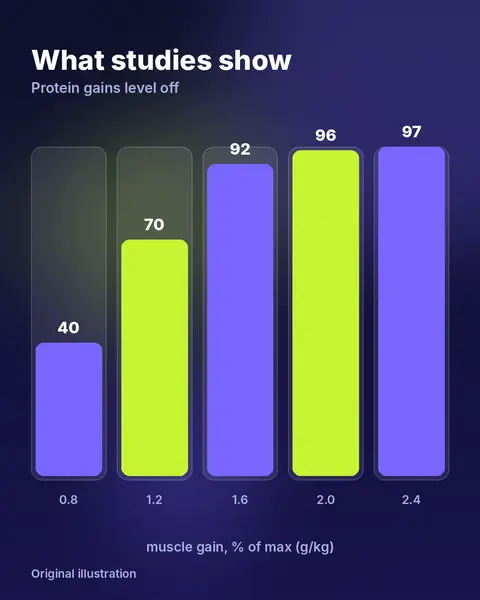
- The RDA of 0.8 g/kg is a minimum to avoid deficiency, not an optimum for active people.
- A meta-analysis of resistance training trials found muscle gains plateaued near 1.6 g/kg, with an upper confidence bound of 2.2 g/kg (Morton et al., 2018).
- In a calorie deficit, higher intakes of about 2.3-3.1 g/kg of lean mass are suggested for lean athletes (Helms et al., 2014).
Original data: protein is cheap in grams, not calories
Reaching 120 g from chicken breast needs about 390 g of cooked chicken and 640 kcal. Reaching it from lentils needs 1,330 g and 1,550 kcal. Source choice matters when calories are limited. See the food macro calculator.
Why height is only a proxy
Protein needs follow lean body mass and training, and height correlates with both only loosely. A 180 cm person can weigh 65 kg or 100 kg, and protein needs differ by 50% between them. The reference weights in the chart come from a BMI of 22, near the centre of the healthy range, which gives a sensible starting point when no other information exists. The BMI calculator shows the healthy range for any height.
How to adjust the chart in three steps
- Start with the chart value for the nearest height and goal.
- Scale for real weight if the body is far from the reference: use something between reference and actual weight when much heavier, and actual weight when lighter.
- Cross-check with the calculator. The protein intake calculator uses age, goal and body fat for a personalised range.
Making it practical
- Split protein across 3-4 meals of 25-40 g.
- Anchor each meal on a protein food first.
- Check totals at the end of the day, not each bite.
How much protein per day by height: what to do next
Use your height to find a range, then check it with the protein intake calculator, which also considers weight, goal and age.
FAQ
How much protein do I need per day?
Between 1.2 and 2.2 g per kg of body weight depending on activity and goal. The chart translates this by height.
Is 100 g of protein a day enough?
For a 60-70 kg person who trains lightly, yes. For a 90 kg lifter in a deficit it is on the low side.
Does height change protein needs?
Indirectly, through body size. Weight and muscle mass matter more.
Can too much protein hurt my kidneys?
In healthy people, intakes up to about 2-3 g/kg have not been shown to harm the kidneys. If you have kidney disease, follow your doctor's advice.
Do I need protein powder?
No, but it is convenient for reaching a target.
Is the protein chart different for women?
Per kilogram, no. Women generally weigh less, so their gram totals are lower at the same height.
Does a taller person need more protein?
Usually, because a taller person usually weighs more. At the same body weight, height has little effect.
Sources
- Dietary Guidelines for Americans (USDA and HHS)
- Morton RW, et al. Br J Sports Med. 2018;52:376-84.
- Helms ER, et al. J Int Soc Sports Nutr. 2014;11:20.
- Institute of Medicine. DRI for Macronutrients. 2005.
- Jäger R, et al. J Int Soc Sports Nutr. 2017;14:20.
Keep going
Muscle Gain Macro Calculator
Lean-bulk surplus by training experience.
Weight Loss Macro Calculator
Pace-based deficit with protein that protects muscle.
Macro Calculator for Men
Targets by size, training and goal.
Macro Calculator for Women
Female-first defaults, safe floors and cycle notes.
What Are Macros?
Protein, carbs and fat explained simply.
How to Calculate Macros
The six-step maths with a worked example.