Updated November 3, 2026 · 5 min read · Sources listed at the end
People who search for a macro calculator reddit threads recommend usually want one thing: a way to tell a trustworthy tool from a confident guess. This page explains why calculators disagree, gives a checklist and shows how to judge any result against a scale trend.
Why this page exists
We are not affiliated with Reddit and we do not quote its users. People who ask about macro calculators on forums tend to ask the same things: which one is accurate, why two calculators give different numbers, and whether the result should be trusted. This page answers those questions directly.
Definition
A macro calculator estimates your daily calories from your body and activity, then splits them into protein, carbohydrate and fat for a goal. It is an estimate, not a measurement.
Why two calculators give different numbers
Calculators differ for four reasons:
- Equation. Mifflin-St Jeor, Harris-Benedict and Katch-McArdle give different BMRs. For an 80 kg, 178 cm, 35-year-old man they give 1,743, 1,816 and 1,787 kcal.
- Activity multiplier. The step from "light" to "very active" is 610 kcal for the same man.
- Goal logic. One tool may subtract a flat 500 kcal, another a percentage of body weight.
- Protein rules. Some use a percentage of calories, others grams per kg. They can differ by 50 g or more.
The ten-point checklist
- Does it show its equation? If not, you cannot judge it.
- Does it set protein in grams per kg? Percentage-only protein is a red flag.
- Does it scale the deficit to body size? A flat 500 kcal is not for everyone.
- Does it have safety limits? Calorie floors and pace warnings.
- Does it let you enter body fat? Lean mass improves accuracy.
- Does it explain activity levels? Vague options cause over-estimates.
- Does it ask for your email before showing results? Be wary.
- Does it tell you to adjust from real data? Good ones do.
- Does it cite sources? Equations should be named and referenced.
- Does it work on your phone? You will use it there.
Sanity-check any result in 60 seconds
- Calories should be within about 10% of your BMR × activity, e.g. 80 kg man: 1,743 × 1.55 = 2,701 kcal.
- Protein should land between 1.4 and 2.2 g per kg for active people.
- Fat should not fall below about 20% of calories, or 0.6 g per kg.
- Weekly loss above about 1% of body weight is aggressive.
Original data: one person, three answers
Same man, same goal (lose 0.5%/week): a flat-500 tool gives 2,201 kcal; a body-weight-percentage tool (this site) gives 2,261; a percentage-of-TDEE tool at 20% gives 2,161. The spread is about 100 kcal, well within the noise of daily weight. Your own weekly weight trend decides which is right for you.
What to do after the first number
Eat the targets for 2-3 weeks, weigh yourself daily, take the weekly average, and adjust by 100-200 kcal if the trend is off. The TDEE calculator and the check-in tab in our macro calculator are built for this loop.
A fair test of any macro calculator
To compare tools, give each one the same inputs and check the output against three reference profiles. The results below come from this site's engine, with Mifflin-St Jeor and the stated activity level.
| Profile | Goal | Calories | Protein |
|---|---|---|---|
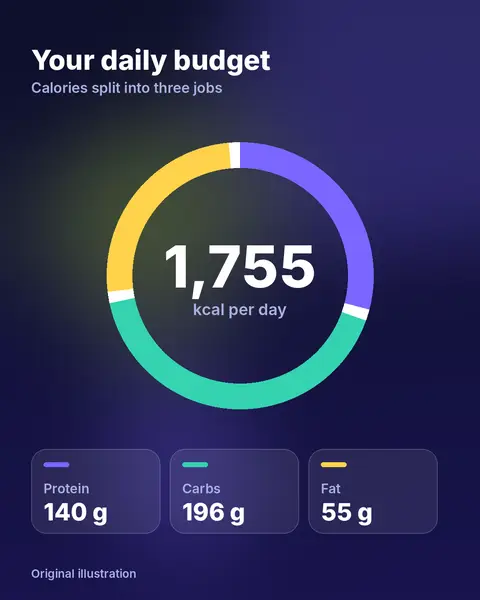
| Woman, 25 y, 165 cm, 60 kg, moderate | Fat loss at 0.5% a week | 1,755 | 120 g |
| Woman, 35 y, 165 cm, 70 kg, light | Fat loss at 0.5% a week | 1,533 | 140 g |
| Man, 35 y, 178 cm, 80 kg, moderate | Maintain | 2,701 | 128 g |
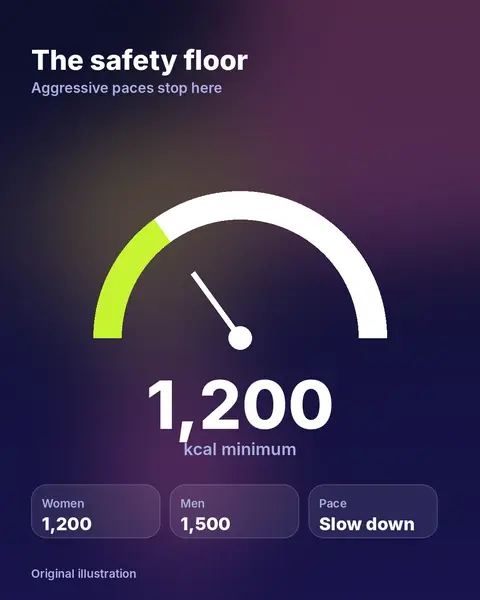
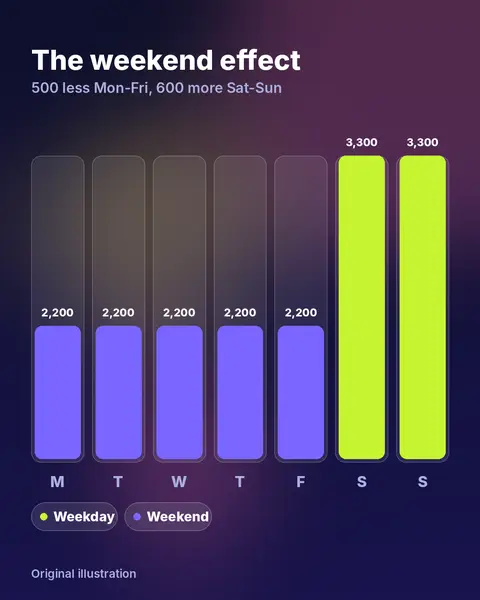
A tool that gives the 60 kg woman 1,200 kcal, or the 80 kg man 3,300, is using a different logic from the one above. That is not automatically wrong, but it should explain why. Tools that cannot explain their equations, floors and protein rules are the ones to avoid.
What forum answers tend to get wrong
- Survivorship. People who report great results with one tool are a self-selected group. Those who quit the same plan rarely post.
- Different activity definitions. One person's "moderate" is three gym days; another's is a physical job. Both type the same word.
- Unmatched goals. A flat 500 kcal cut and a 0.5% a week cut are different plans, even when both are called "a deficit".
- Single-day weights. A one-day scale reading can swing 1 to 2 kg from water alone, so a weight report after one weekend means little.
Red flags in a macro calculator
- Email required to see results.
- No named equation or sources.
- Calorie floors that do not exist, or that suggest 1,000 kcal for a typical adult.
- Fixed percentage splits with no protein in grams per kilogram.
- Results with no way to adjust from real weight data.
Our take: what is overrated, underrated and wrong
Finding the "most accurate" calculator. None can know your metabolism.
Your own scale trend. It is the only data that is actually about you.
Switching calculators every time progress stalls.
Using a macro calculator Reddit threads recommend
Threads usually point to the same idea: start from a sensible estimate, track for two to three weeks and adjust. Our macro calculator gives that starting estimate.
FAQ
Which macro calculator is most accurate?
None can be exactly accurate. Look for transparent equations, body-size-based protein and safety limits, then adjust from your own results.
Why does my calculator say different calories than my smartwatch?
Wearables estimate burn from movement and heart rate, and calculators from formulas. Neither is exact.
Should I trust a macro calculator?
Trust it as a starting estimate and verify with 2-3 weeks of data.
Is IIFYM different from a macro calculator?
IIFYM is a style of eating that uses the targets. See IIFYM.
Do I need to pay for a macro calculator?
No. Good free calculators exist; what matters is transparency.
Is the Mifflin-St Jeor equation the best one?
For people without body-fat data, it is the equation with the best published accuracy (Frankenfield et al., 2005). With a reliable body-fat figure, Katch-McArdle can be a better fit, especially for lean or muscular people.
Why does my smartwatch show a different calorie number?
Watches estimate active calories from movement and heart rate and often add their own resting-energy figure. Independent tests have found large errors in both, so a scale trend is a better judge than either number.
How long should I follow one calculator before switching?
Three weeks of consistent logging and daily weights gives enough data to adjust. Changing tools every few days resets the experiment.
Sources
- Mifflin MD, et al. Am J Clin Nutr. 1990;51:241-7.
- Roza AM, Shizgal HM. Am J Clin Nutr. 1984;40:168-82.
- Morton RW, et al. Br J Sports Med. 2018;52:376-84.
- Hall KD, et al. Lancet. 2011;378:826-37.
Keep going
TDEE Calculator
Maintenance calories and targets for each goal.
How to Calculate Macros
The six-step maths with a worked example.
What Are Macros?
Protein, carbs and fat explained simply.
IIFYM Calculator
Flexible dieting macros and guardrails.
Best Macro Tracking Apps
How to choose a tracker, with a checklist.
Not Losing Weight on Macros?
Seven reasons and a two-week test.