Updated November 3, 2026 · 4 min read · Sources listed at the end
Why women over 40 need a different default
Definition
A macro calculator for women over 40 sets a higher protein share, a slower deficit and a calorie floor, because muscle and bone become easier to lose and harder to rebuild as oestrogen declines through perimenopause and menopause.
Three changes make the 40s and 50s different:
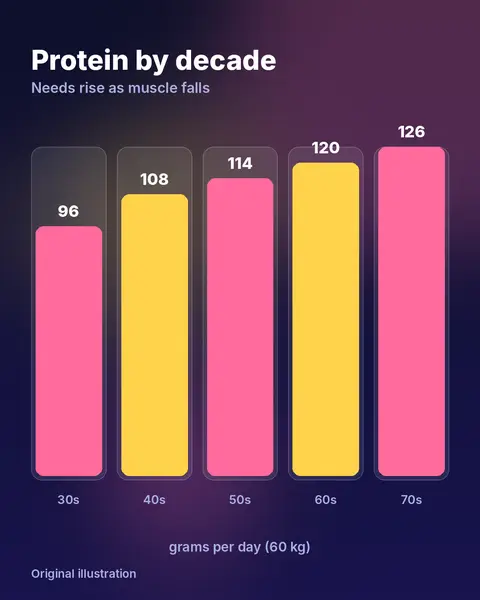
- Muscle loss quickens. Without resistance training and enough protein, adults lose roughly 3-8% of muscle per decade after about age 30, and the pace increases in later decades.
- Calorie needs drift down. Age appears in the equation: Mifflin-St Jeor subtracts 5 kcal of BMR per year of age.
- Bone density declines after menopause, which is another reason muscle-loading exercise and protein are worth protecting.
What the calculator does by default
- Sets protein near 2.2 g per kg of body weight (high-protein style).
- Uses a 0.35% per week pace, gentler than the standard 0.5%.
- Uses a light activity level unless you change it. Many women overestimate.
- Applies the standard 1,200 kcal floor and warnings.
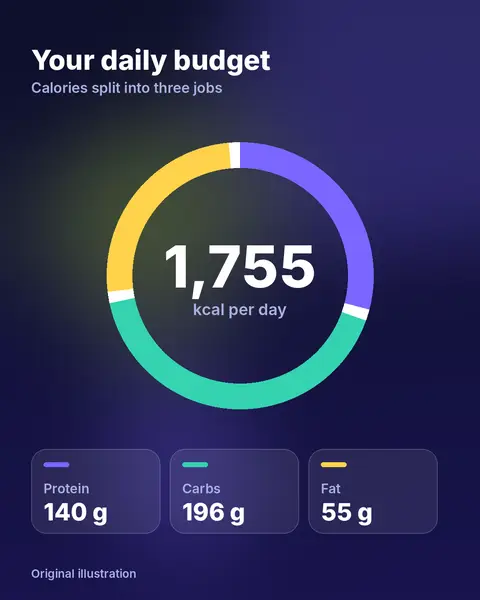
Real outputs for a 45-year-old woman
Profile: 165 cm, 68 kg, light activity, high-protein style.
| Goal | Calories | Protein | Carbs | Fat |
|---|---|---|---|---|
| Maintain | 1,822 | 150 g | 192 g | 51 g |
| Fat loss at 0.35%/wk | 1,560 | 150 g | 143 g | 43 g |
| Fat loss at 0.5%/wk | 1,448 | 145 g | 127 g | 40 g |
| Recomp (moderate activity) | 2,054 | 150 g | 235 g | 57 g |
Notice that protein stays at roughly 150 g in every case. As calories fall, carbs shrink first and protein stays put.
Original data: how age shifts maintenance calories
Same woman, 165 cm, 68 kg, light activity, balanced style. Calculated maintenance at age 30 is 1,925 kcal; at 45 it is 1,822 kcal; at 55 it is 1,753 kcal. That is a drop of about 172 kcal per day from 30 to 55 from age alone, about the calories in a medium banana plus a tablespoon of peanut butter. Losing muscle can lower it further, which is why strength training and protein matter.
The four-part midlife plan
1. Protein at every meal
Aim for 30-40 g of protein per meal, because older adults need a larger dose to maximally stimulate muscle building (a concept called anabolic resistance). Greek yogurt, eggs, fish, chicken, tofu, lentils and protein powder all work.
2. Strength training two to three times a week
Lifting is the signal that tells the body to hold onto muscle and bone while calories drop. Choose compound movements (squat variations, hinges, presses, rows) and add reps or weight slowly over time.
3. Walk daily
Aim for 7,000-10,000 steps. It adds energy burn without extra stress on recovery.
4. Sleep and stress
Sleep loss increases appetite and cravings. Perimenopause can disrupt sleep; handle it with your clinician rather than cutting calories harder.
Nutrients to prioritise after 40
| Nutrient | Why | Sources |
|---|---|---|
| Protein | Muscle, satiety | Dairy, eggs, fish, poultry, legumes, tofu |
| Calcium (1,200 mg after 50) | Bone | Dairy, fortified plant milks, sardines, tofu set with calcium |
| Vitamin D | Calcium absorption | Sunlight, oily fish, fortified foods, supplements if advised |
| Fibre | Gut health, fullness | Oats, beans, berries, vegetables |
| Omega-3 | Heart and joint health | Salmon, sardines, walnuts, flax |
What the research says
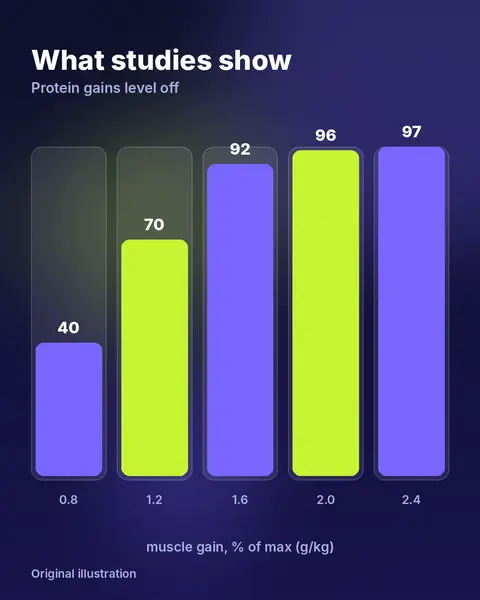
- Anabolic resistance. Studies of older adults suggest that a higher per-meal protein dose (roughly 0.4 g per kg per meal) is needed to get the same muscle-building response as younger people (Moore et al., 2015).
- Overall protein. A position paper by the PROT-AGE group recommended 1.0-1.2 g/kg for healthy older adults and more for those who are exercising or ill (Bauer et al., 2013). The 2025-2030 US Dietary Guidelines suggest 1.2-1.6 g/kg for adults generally. Active women dieting often benefit from the higher end.
- Resistance training. A large body of evidence shows strength training improves muscle mass, bone density and metabolic health in midlife and older women.
Our take: what is overrated, underrated and wrong
"Hormone-balancing" detoxes and supplements. Few have strong evidence; protein, lifting and sleep do.
Slow weight loss. Losing 0.3-0.5% of body weight per week preserves more muscle and is more livable at this stage.
"Metabolism is broken after 40." It declines modestly with age and muscle loss, but it is not broken. Strength training and protein are the correction.
How to start
- Check your numbers in the calculator above with your real height, weight and a realistic activity level.
- Build three high-protein meals first; add snacks only if needed.
- Lift twice a week to start; progress slowly.
- Review every two weeks with the Check-in tab.
- Discuss anything unusual (heavy bleeding, extreme fatigue, rapid weight change) with a clinician.
FAQ
How many calories should a 45-year-old woman eat?
For a 165 cm, 68 kg woman with light activity, maintenance is about 1,820 kcal and fat loss around 1,450-1,560 kcal. Your own numbers depend on size and activity.
How much protein do women over 40 need?
Aim for about 1.6-2.2 g per kg of body weight (0.7-1.0 g per lb), spread over three or four meals with 30-40 g each.
Is intermittent fasting good after 40?
It can work if you reach your protein and calorie targets in a shorter window, but it is not required. See the intermittent fasting macro calculator.
Should I lift weights during menopause?
Yes. Resistance training helps protect muscle and bone, both of which become more vulnerable after menopause.
Why is the scale stuck?
Water retention, sleep, stress and hormone shifts can mask fat loss. Judge progress with a weekly average, waist and strength over 3-4 weeks.
Sources
- Moore DR, et al. Protein ingestion to stimulate myofibrillar protein synthesis requires greater relative protein intakes in healthy older versus younger men. J Gerontol A Biol Sci Med Sci. 2015;70(1):57-62.
- Bauer J, et al. Evidence-based recommendations for optimal dietary protein intake in older people: a position paper from the PROT-AGE Study Group. J Am Med Dir Assoc. 2013;14(8):542-559.
- Volpi E, et al. Curr Opin Clin Nutr Metab Care. 2004;7(4):405-410.
- Mifflin MD, et al. Am J Clin Nutr. 1990;51(2):241-247.
- NIH Office of Dietary Supplements. Calcium and Vitamin D fact sheets.
Keep going
Macro Calculator for Women
Female-first defaults, safe floors and cycle notes.
Body Recomp Calculator
Maintenance calories, high protein, smart carb cycling.
Weight Loss Macro Calculator
Pace-based deficit with protein that protects muscle.
What Are Macros?
Protein, carbs and fat explained simply.
Intermittent Fasting Calculator
Per-meal macros for any eating window.
Protein Per Day by Height
A chart of protein ranges by height.