Updated November 3, 2026 · 5 min read · Sources listed at the end
A macro to calorie calculator converts grams of protein, carbs and fat into total calories and shows each macro's share.
The macro to calorie formula
Definition
A macro to calorie conversion multiplies the grams of each macronutrient by its energy value: protein 4, carbohydrate 4, fat 9 and alcohol 7 kcal per gram. Adding the results gives the total calories.
Total calories = (protein g × 4) + (carbohydrate g × 4) + (fat g × 9) + (alcohol g × 7)
These factors are called Atwater factors, after the American chemist Wilbur Atwater, who burned foods in a calorimeter and measured digestion at the end of the 19th century. They are averages, not laws of nature, but they hold up well enough that almost every nutrition label and tracking app still relies on them.
How to use the macro to calorie calculator in three steps
- Enter grams. Type protein, carbohydrate and fat. Add alcohol grams if relevant.
- Read the total. Calories and the percentage of each macro appear immediately.
- Compare with a target. If the total is far from the daily goal, adjust the macro with the most room, usually carbohydrate or fat. The macro calculator sets the target itself.
Worked example: a day of 150 g protein, 250 g carbs and 70 g fat
- Protein: 150 × 4 = 600 kcal
- Carbohydrate: 250 × 4 = 1,000 kcal
- Fat: 70 × 9 = 630 kcal
- Total: 2,230 kcal
The split is 27% protein, 45% carbohydrate and 28% fat. Fat makes up only 70 of the 470 grams eaten (15% of the weight) yet supplies 28% of the calories, which is why fat is the usual suspect when a plan runs over.
What about alcohol?
Alcohol is not a macronutrient, but it carries 7 kcal per gram, nearly as much as fat. A US standard drink contains about 14 g of pure alcohol, so two drinks add roughly 196 kcal (28 × 7) before any sugar in the mixer. Those calories do not count toward protein, carbohydrate or fat, so they leave a gap in a macro log. Most trackers handle it with a separate alcohol line, and the calculator above does the same.
Why labels sometimes do not add up
A food label can differ from a straight 4-4-9 sum by 5 to 10% for legitimate reasons:
- Fibre provides about 2 kcal per gram in many regulatory systems, and some labels subtract it from carbohydrate.
- Sugar alcohols such as erythritol supply little or no energy, so a "20 g carbs" bar may be far fewer calories than 80.
- Rounding. Each nutrient is rounded to the nearest gram, and small foods can show large percentage errors.
- Specific factors. Some foods, such as nuts and whole grains, use food-specific Atwater values because they are digested less completely.
A hypothetical protein bar lists 20 g protein, 22 g carbohydrate (6 g of it fibre) and 8 g fat. The raw sum is 80 + 88 + 72 = 240 kcal. Counting the 6 g of fibre at 2 kcal instead of 4 gives 228 kcal, which is close to what many labels would show. A 5% difference like that is normal and not worth chasing.
Quick conversion table
| Grams | Protein or carbs | Fat | Alcohol |
|---|---|---|---|
| 10 g | 40 kcal | 90 kcal | 70 kcal |
| 25 g | 100 kcal | 225 kcal | 175 kcal |
| 50 g | 200 kcal | 450 kcal | 350 kcal |
| 100 g | 400 kcal | 900 kcal | 700 kcal |
Going the other way: calories to grams
When calories are fixed and the grams are unknown, the macro percentage calculator works backwards: grams = calories × percentage ÷ kcal per gram. For a goal-aware answer with protein set from body weight, the full free macro calculator does the whole chain.
Original data: where 500 kcal goes by macro
A 500 kcal budget buys 125 g of protein, or 125 g of carbohydrate, or only 56 g of fat. In practice, 500 kcal of chicken breast and rice is a large plate, while 500 kcal of oil, nuts and cheese is a handful. The bulk is not the point; the calorie density of fat is.
A habit that makes conversions easier
Memorise "4, 4, 9" and two reference points: 100 g of cooked rice is about 130 kcal and 100 g of cooked chicken breast about 165 kcal. With those, a quick plate estimate lands within 10 to 15% without any calculator, and a weighed log can then correct the rest.
Common mistakes with macro conversions
- Using 4 for fat. The most common slip. Fat is 9, and the error undercounts calories quickly.
- Forgetting cooking oil. One tablespoon of oil is about 13.5 g fat and 120 kcal, and it often goes unlogged.
- Treating "net carbs" as the label number. Net carbs are a keto convention, not an energy rule. The calculator converts the carbohydrate grams you enter.
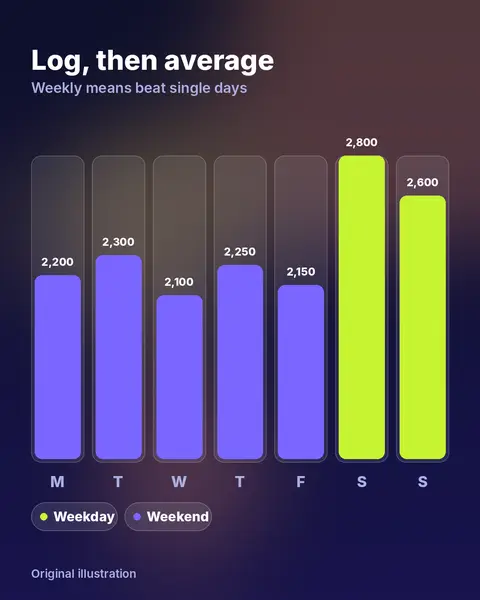
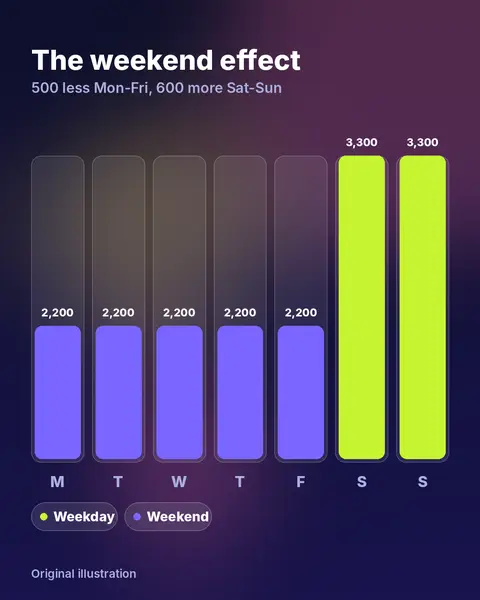
- Trusting totals to the last calorie. Real intake varies by 5 to 10% around any label, so weekly averages matter more than a single day.
Our take: what is overrated, underrated and wrong
Exact calorie precision. Labels, cooking methods and digestion vary, so a day within 5% of target is a successful day.
Knowing how calorie-dense fat is. It explains most "I ate healthy and still gained" stories.
Ignoring alcohol because it is not a macro. It is energy, and it adds up.
FAQ
How many calories are in a gram of protein, carbs and fat?
Protein and carbohydrate contain 4 kcal per gram, fat 9 and alcohol 7.
How do I convert macros to calories?
Multiply each macro's grams by its kcal value and add the results. A day with 150 g protein, 250 g carbs and 70 g fat comes to 2,230 kcal.
Why is my label total different from my calculation?
Fibre, sugar alcohols and rounding are the usual causes. A gap of 5 to 10% is normal.
Can I convert calories to macros?
Yes. Choose a split and divide: grams = calories × percentage ÷ kcal per gram. The macro percentage calculator does it for you.
Do I count alcohol as a macro?
It is not a macronutrient, but it supplies 7 kcal per gram, so it belongs in the calorie total.
Are the 4-4-9 values exact?
They are averages from Atwater's work, with food-specific adjustments used by many agencies. For tracking purposes they are accurate enough.
Sources
- Dietary Guidelines for Americans (USDA and HHS)
- Atwater WO, Bryant AP. The availability and fuel value of food materials. 1900.
- FAO. Food energy: methods of analysis and conversion factors. FAO Food and Nutrition Paper 77. 2003.
- National Institute on Alcohol Abuse and Alcoholism. What is a standard drink?
Keep going
Macro Percentage Calculator
Turn a calorie target and percentage split into grams.
What Are Macros?
Protein, carbs and fat explained simply.
How to Calculate Macros
The six-step maths with a worked example.
Food Macro Calculator
Search foods and log against your daily targets.
Recipe Macro Calculator
Macros per serving from your ingredient list.
IIFYM Calculator
Flexible dieting macros and guardrails.