Updated November 3, 2026 · 6 min read · Sources listed at the end
This macro calculator for muscle gain sets a small, controlled calorie surplus, a protein target in grams per kilogram and enough carbohydrate to train hard. The sections below explain surplus size by training experience, protein, fat, carbs and how to tell from the scale and the tape whether a lean bulk is working.
How a muscle gain macro calculator works
Definition
A muscle gain macro calculator adds a modest calorie surplus to your maintenance calories, sets protein high enough to supply the raw material for new tissue, and puts the remaining calories mainly into carbohydrate to fuel training and recovery.
Building muscle needs three things at once: a training stimulus that is hard enough, protein that is high enough, and energy that is plentiful enough. A calculator can only help with the last two. The calories and macros above assume you are lifting weights progressively at least three days a week. Without that stimulus, a surplus just makes you heavier.
The surplus depends on how trained you are
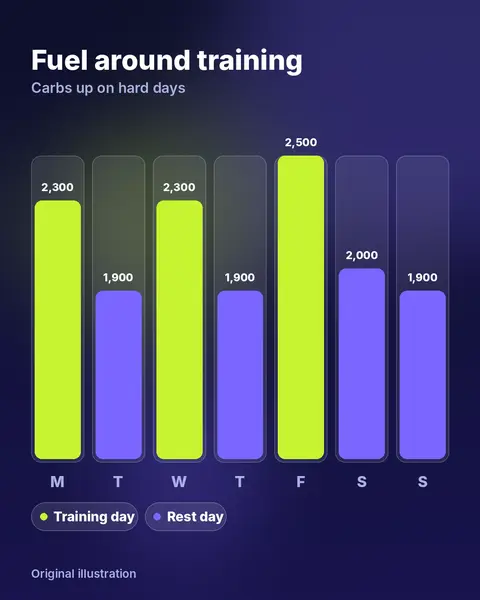
New lifters can add muscle quickly because everything is a novel stimulus. Experienced lifters are close to their genetic ceiling and add tissue slowly. A surplus bigger than your body can use goes to fat storage. So the calculator asks for your training experience and sets the target pace as a share of body weight per month:
| Experience | Monthly gain target | Daily surplus (75 kg man) | Calories (maintenance 2,701) |
|---|---|---|---|
| Beginner (under 1 year) | 1.5% | +289 kcal | 2,990 |
| Novice (1-2 years) | 1.0% | +193 kcal | 2,893 |
| Intermediate (2-5 years) | 0.5% | +96 kcal | 2,797 |
| Advanced (5+ years) | 0.25% | +48 kcal | 2,749 |
Those surpluses are smaller than the "eat 500 extra" advice you may have seen, and that is the point. A 500 kcal surplus works out to roughly 1.5 lb of gain per week for months on end, and nobody builds 1.5 lb of muscle a week. The remainder lands on your waistline.
Hard gainers
If your weight does not move after three weeks at the calculated calories, your real maintenance is higher than the equation guessed, often because of unconscious movement such as fidgeting and pacing. Add 150-250 kcal a day and recheck in two weeks. The Check-in tab calculates this for you.
Protein, carbs and fat for muscle gain
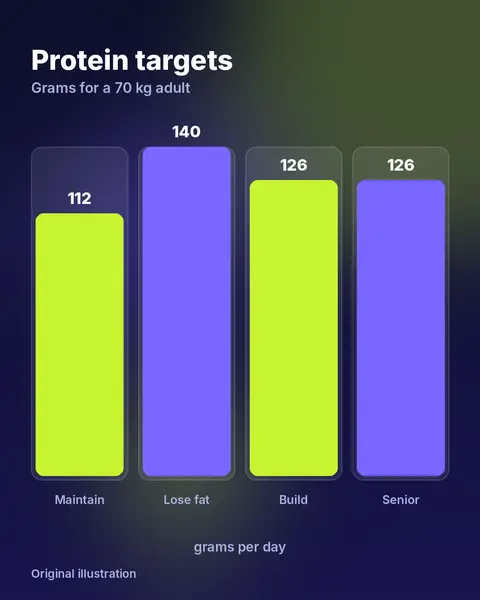
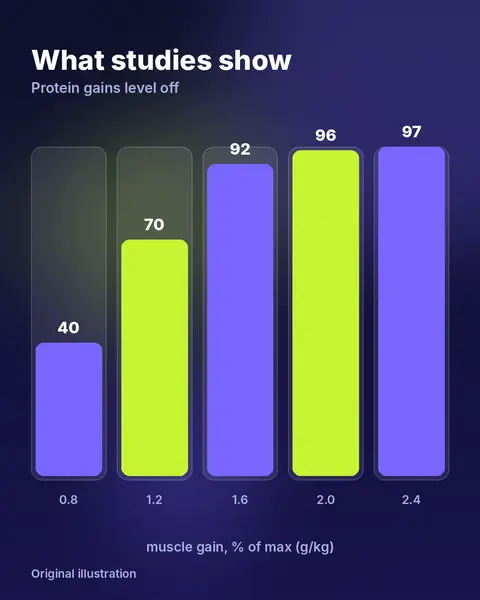
Protein is set at about 1.8 g per kg of body weight (0.8 g per lb), or about 2.0 g per kg of lean mass if you enter body fat. That is close to the 1.6 g/kg point where Morton and colleagues (2018) found the benefit of extra protein flattening out in a meta-analysis of 49 trials. Our default sits a touch above the average to cover individual variation, and below the heights where extra protein just displaces carbs.
Carbohydrate gets the largest share of the rest. Carbs refill muscle glycogen, which lets you train with more volume, and that volume is the actual driver of growth. Fat sits around 25-28% of calories.
| 75 kg man, novice | Calories | Protein | Carbs | Fat |
|---|---|---|---|---|
| Maintenance | 2,701 | 120 g | 366 g | 84 g |
| Novice lean bulk | 2,893 | 135 g | 386 g | 90 g |
| Beginner faster bulk | 2,990 | 135 g | 403 g | 93 g |
A 60 kg woman: same logic, smaller numbers
For a 28-year-old woman at 165 cm and 60 kg with moderate activity, the calculator gives about 2,293 kcal as a beginner, 2,216 as a novice, 2,139 as an intermediate and 2,100 as an advanced lifter, with protein around 108 g in every case. Women generally do not need a different ratio, only a different total. See the macro calculator for women for the extra considerations.
Meal timing: what matters and what does not
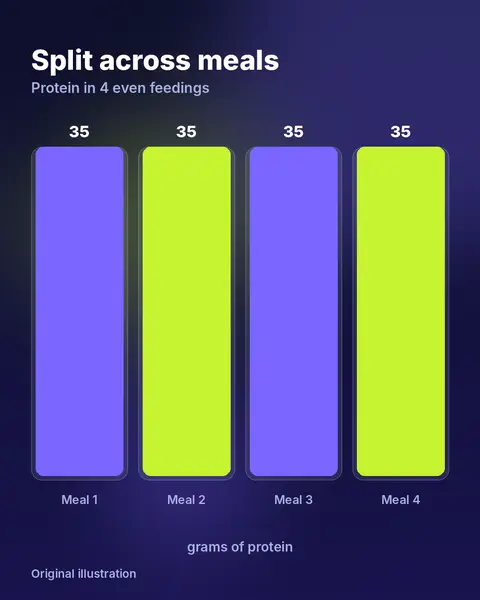
- Total daily protein matters most. Spread it over three to five meals, each with roughly 25-40 g.
- The "anabolic window" is wider than gym folklore claims. Eating a protein-containing meal within a few hours either side of training is plenty.
- Pre-workout carbs help if you train hard or early. A banana and yogurt is enough.
- Before bed, 30-40 g of casein or Greek yogurt is a simple option but not required.
What the research says
- Protein plateau. Morton et al. (2018): benefits from higher protein plateaued at about 1.6 g/kg/day, with the upper confidence limit near 2.2 g/kg.
- Position stands. The International Society of Sports Nutrition suggests 1.4-2.0 g/kg per day for most exercising people (Jager et al., 2017).
- Rates of gain. Commonly cited coaching guidelines put novices at roughly 1-1.5% of body weight per month and advanced lifters near 0.25-0.5%. We use these as defaults; your own scale and tape measure should overrule them.
Original data: what a faster bulk really buys
Taking our 75 kg man from "advanced" to "beginner" pacing adds 241 kcal a day. Over a 12-week bulk, the calculator's energy-balance model puts the difference at about 2.4 kg of additional body weight (about 77.6 kg versus 75.1 kg). Only a fraction of the extra can be muscle at that stage of training; the rest is fat you would later need to diet off. At advanced pacing the model has the scale barely moving, which is realistic: late-stage muscle gain is measured in months and years.
Our take: what is overrated, underrated and wrong
"Dirty bulking" and weight-gain shakes. A surplus of 200-300 kcal builds muscle at nearly the same rate as 800 kcal, without the cleanup later.
Sleep and progressive overload. Seven to nine hours of sleep and adding reps or weight over time beat every supplement.
Assuming 2 g of protein per pound of body weight is required. It is not; about 0.7-1.0 g per lb is plenty for nearly everyone.
How to run your first 8 weeks
- Weeks 1-2: eat the calculated calories, weigh yourself daily, and take a waist measurement at the navel once a week.
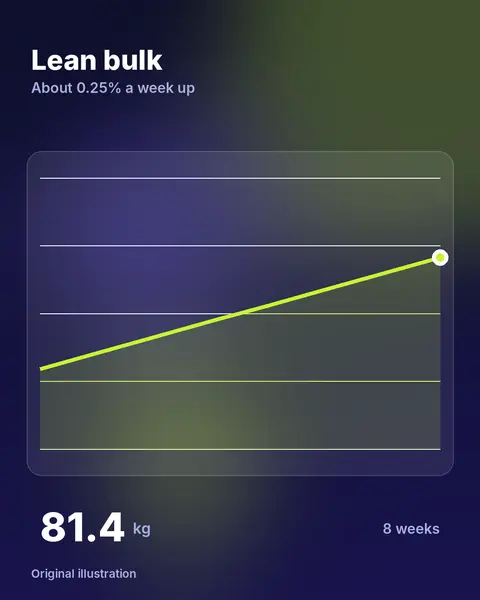
- Weeks 3-4: compare your weekly average weight with the monthly pace. Aim for about a quarter of the monthly target each week.
- Weeks 5-8: if you are gaining faster than planned and the waist is growing, remove 100-150 kcal. If gaining slower and lifts are stuck, add 100-150 kcal.
- After a block of 12-16 weeks, consider a short maintenance phase or a mini-cut. Constant bulking dulls the benefit.
Common muscle gain mistakes
- Starting with a huge surplus. It cannot be undone quickly.
- Training without a log. If you do not know last week's numbers, you cannot do progressive overload.
- Under-eating on rest days. Muscle is built while you recover.
- Chasing the scale only. Use waist, mirror and gym performance together.
FAQ
How many calories do I need to build muscle?
Eat slightly above maintenance: roughly +50 kcal a day for advanced lifters up to about +300 kcal for beginners. The calculator picks the number from your training experience and body weight.
How much protein should I eat to gain muscle?
Aim for about 1.6-2.2 g per kg of body weight per day (0.7-1.0 g per lb). This calculator defaults to about 1.8 g/kg for muscle gain.
Can I build muscle in a calorie deficit?
Beginners, people returning after a break, and people carrying higher body fat can. For leaner, experienced lifters it is slow, which is why a recomposition plan or a cut-then-bulk cycle is more efficient.
Should I bulk on a high-carb or a high-fat diet?
Either works if calories and protein are right. Most lifters train better with ample carbs, which is why the default split favours them.
How do I know if I am gaining too fast?
If your weekly average weight rises more than about 0.25-0.5% of body weight per week for several weeks, or your waist grows quickly, reduce calories by 100-150 kcal.
Do I need supplements?
No. Creatine monohydrate has strong evidence for strength and lean mass, and whey is a convenient protein source. Neither is required.
Sources
- Morton RW, et al. Br J Sports Med. 2018;52:376-384.
- Jager R, et al. International Society of Sports Nutrition position stand: protein and exercise. J Int Soc Sports Nutr. 2017;14:20.
- Mifflin MD, et al. Am J Clin Nutr. 1990;51(2):241-247.
- Institute of Medicine. Dietary Reference Intakes for Macronutrients. National Academies Press, 2005.
Keep going
Bodybuilding Calculator
Lean-mass bulk and cut macros.
Body Recomp Calculator
Maintenance calories, high protein, smart carb cycling.
Macro Calculator for Men
Targets by size, training and goal.
Vegetarian & Vegan Calculator
Plant-protein adjusted targets and vegan sample days.
How to Calculate Macros
The six-step maths with a worked example.
Protein Per Day by Height
A chart of protein ranges by height.