Updated November 3, 2026 · 5 min read · Sources listed at the end
This macro calculator for body recomp sets calories near maintenance, protein high and carbohydrate around training so fat can fall while muscle builds. Body recomposition suits beginners, people returning to training and anyone carrying extra body fat, and the sections below explain who it fits and how to run a clean twelve weeks. Want the muscle side of the picture? Try the lean body mass calculator.
What is body recomposition?
Definition
Body recomposition (recomp) is the process of reducing body fat and increasing muscle mass over the same period, so your shape changes more than your scale weight does.
Standard advice says you must pick one: eat less to lose fat, or eat more to build muscle. For most experienced, lean lifters that is basically true. But for several groups the two can overlap: people new to lifting, people returning after a layoff, people carrying extra body fat, and people who are increasing protein from a low baseline. For them, a recomp plan can be the best use of a few months.
Who recomp works best for
| Situation | Recomp potential | Why |
|---|---|---|
| Beginner lifter | High | Muscle responds quickly to a new stimulus |
| Returning after a layoff | High | "Muscle memory" speeds regaining lost tissue |
| Carrying extra body fat | High | Stored energy can help fuel muscle growth |
| Low protein before, high protein now | Medium-high | A big change in the main building block |
| Lean intermediate lifter | Low-medium | Both goals compete; cut then bulk is faster |
| Advanced and lean | Low | Close to the ceiling; slow in either direction |
If you are in the bottom two rows, a conventional cut or bulk will probably get you there faster. Be honest about where you stand.
How the calculator sets a recomp
- Calories at maintenance. No big deficit or surplus. This is the middle ground where fat can be mobilised and muscle still has energy to grow.
- Protein high. About 2.0 g per kg of body weight, or about 2.2 g per kg of lean mass when you enter body fat.
- Carbs placed around training. The carb cycling switch is on by default. Training days get roughly 8% more calories, all from carbs; rest days get a proportional reduction so the weekly average still equals maintenance.
- Fat steady around 28% of calories on both day types.
A worked example
A 38-year-old man, 178 cm, 88 kg, 24% body fat, training four days a week. Because he knows his body fat, the calculator uses Katch-McArdle (lean mass 66.9 kg), giving a BMR of about 1,815 kcal and maintenance of about 2,813 kcal at moderate activity.
| Day type | Calories | Protein | Carbs | Fat |
|---|---|---|---|---|
| Training day (4 per week) | 3,038 | 147 g | 415 g | 88 g |
| Rest day (3 per week) | 2,513 | 147 g | 283 g | 88 g |
| Weekly average | 2,813 | 147 g | 359 g | 88 g |
Protein and fat never move. Only carbs rise or fall, which keeps the plan simple and stops fat intake from creeping up.
How to know it is working
The scale will barely move, so use other measures:
- Waist circumference at the navel, once a week, same time of day. It should drift down.
- Strength. Your main lifts should rise, or reps at the same weight should climb.
- Photos every 4 weeks, same lighting and pose.
- Clothes. Trousers get looser while shirts get tighter in the shoulders.
Give it 8-12 weeks. If your waist is unchanged and your lifts are flat after that, change the plan: a small deficit (about 10% below maintenance) if you want to lose fat, or a small surplus if you want to build.
How to run a clean 12 weeks
Take a baseline: weight (average of 7 days), waist, a set of photos and a top-set for each main lift. Eat the calculated numbers for 4 weeks without changing anything. At week 4 compare. If strength is rising and the waist is stable or down, continue. If strength is flat and the waist is up, drop calories by 100-150 kcal. Repeat at weeks 8 and 12. Only ever change one variable at a time.
What the research says
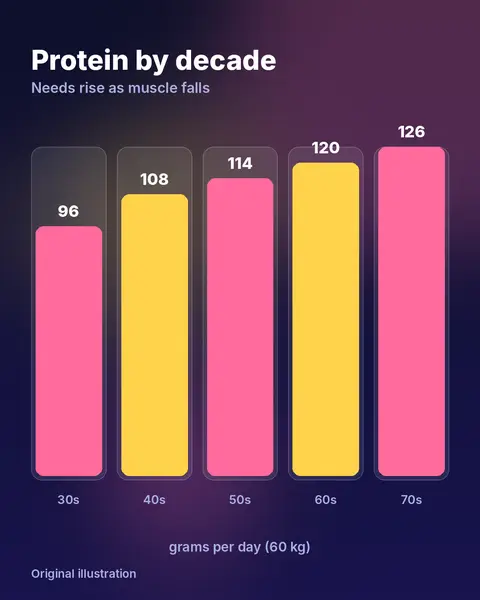
- Higher protein helps both sides. Barakat and colleagues (2020) reviewed recomposition research and concluded that resistance training combined with adequate (high) protein is the key set of conditions, and that results are strongest in untrained people and those returning to training.
- Energy availability matters. Muscle growth is easier near or above maintenance, which is why recomp calories stay close to TDEE instead of dropping into a deficit.
- Measurement is hard. Body-fat scales and calipers can mislead by several percentage points. Use waist and strength as your primary evidence.
Original data: carb cycling changes the plate, not the weekly total
With four training days per week, the engine lifts training-day calories 8% (+225 kcal) and trims rest days by 10.6% (−300 kcal). Over a week that nets to zero: 4 × 3,038 + 3 × 2,513 = 19,691 kcal, which divided by seven is 2,813 kcal. The total is unchanged; only the timing of carbohydrate moves.
Our take: what is overrated, underrated and wrong
Precise carb cycling. If you are within 5% of weekly calories and protein, the day-by-day pattern is a small bonus, not the engine.
Patience. Recomp results arrive in 12-week blocks, not 12-day ones, and measurement noise hides early progress.
"You can't lose fat and gain muscle at once." You can, depending on training status. "Anyone can do it at any level" is equally wrong.
Mistakes that stall a recomp
- Not lifting progressively. Without rising loads or reps there is no signal to build muscle.
- Eating at a deficit and a surplus on alternating days with no logic. Keep the weekly average at maintenance.
- Trusting a smart scale. Use it for trends only, if at all.
- Quitting at week 6. The tape measure moves later than motivation.
FAQ
What calories should I eat for body recomposition?
Start at your estimated maintenance calories, which the calculator provides, and keep protein at roughly 2 g per kg of body weight. Adjust by 100-150 kcal after four weeks based on your waist and strength trend.
Can I do a recomp without lifting weights?
Not effectively. Resistance training is the stimulus that tells your body to keep or build muscle while fat is being lost.
Is body recomposition faster than cutting then bulking?
For beginners, returners and people with higher body fat, it can be. For lean intermediate and advanced lifters, separate cutting and bulking phases are usually faster.
How much protein for a recomp?
Around 1.8-2.2 g per kg of body weight (0.8-1.0 g per lb) is a practical target, spread across three or four meals.
Do I need to cycle carbs?
No. It is optional. Eating the same macros every day also works; turn the switch off in Advanced settings.
How long does recomp take?
Expect to judge progress over 8-12 weeks. Visible changes in the mirror often need 12-16 weeks.
Sources
- Dietary Guidelines for Americans (USDA and HHS)
- Barakat C, Pearson J, Escalante G, Campbell B, De Souza EO. Body recomposition: can trained individuals build muscle and lose fat at the same time? Strength Cond J. 2020;42(5):7-21.
- Morton RW, et al. Br J Sports Med. 2018;52:376-384.
- Katch FI, McArdle WD. Prediction of body density and lean body mass equations. Nutrition, Weight Control and Exercise, 1977.
- Jager R, et al. J Int Soc Sports Nutr. 2017;14:20.
Keep going
Muscle Gain Macro Calculator
Lean-bulk surplus by training experience.
Weight Loss Macro Calculator
Pace-based deficit with protein that protects muscle.
Carb Cycling Calculator
High and low carb days that average to your target.
Macro Calculator for Men
Targets by size, training and goal.
Women Over 40 Calculator
Protein-first, strength-supported targets.
IIFYM Calculator
Flexible dieting macros and guardrails.