Updated November 3, 2026 · 5 min read · Sources listed at the end
Learning how to calculate macros takes six steps: estimate calories, set a goal, fix protein, set fat, fill the rest with carbs and check the total.
The six steps at a glance
- Estimate your BMR (calories at rest).
- Multiply by an activity factor to get maintenance (TDEE).
- Adjust calories for your goal.
- Set protein in grams.
- Set fat in grams.
- Give the remaining calories to carbohydrate.
Definition
Calculating macros means converting a daily calorie target into grams of protein, carbohydrate and fat using calories-per-gram values of 4, 4 and 9.
Step 1: Estimate your BMR
BMR (basal metabolic rate) is the energy your body uses at complete rest. The most widely used predictor for healthy adults is the Mifflin-St Jeor equation:
- Men:
BMR = 10 × weight (kg) + 6.25 × height (cm) − 5 × age + 5 - Women:
BMR = 10 × weight (kg) + 6.25 × height (cm) − 5 × age − 161
To convert: pounds ÷ 2.2046 = kilograms; inches × 2.54 = centimetres.
If you know your body-fat percentage, use Katch-McArdle: BMR = 370 + 21.6 × lean body mass (kg), where lean mass = weight × (1 − body fat %).
Step 2: Multiply by activity
| Activity | Factor |
|---|---|
| Desk life, little exercise | 1.2 |
| Light, 1-3 workouts/week | 1.375 |
| Moderate, 3-5 workouts/week | 1.55 |
| Very active, 6-7 workouts/week | 1.725 |
| Athlete or physical job plus training | 1.9 |
TDEE = BMR × activity factor
Step 3: Adjust for your goal
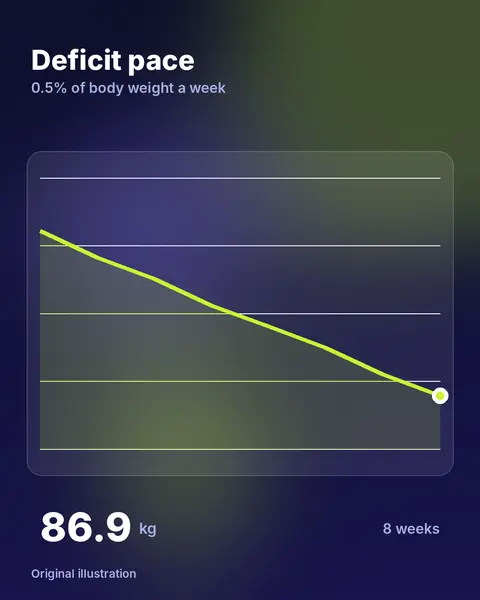
- Lose fat: subtract about 15-25% of TDEE, or use a pace:
daily deficit = weight (kg) × pace% × 7700 ÷ 7. - Maintain: use TDEE.
- Build muscle: add roughly 5-12% of TDEE, or use a monthly pace:
daily surplus = weight (kg) × monthly% × 7700 ÷ 30.
Step 4: Protein
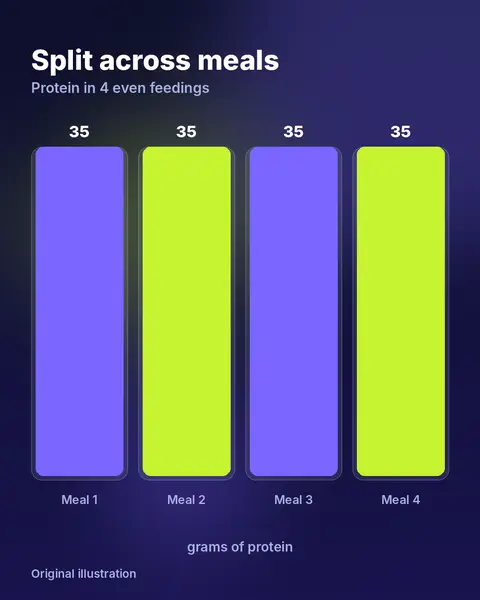
Pick a grams-per-kilogram figure: about 1.6 g/kg to maintain, 1.8 g/kg to build and 2.0 g/kg while dieting. Multiply by your weight in kg. Then multiply by 4 to see the calories protein takes.
Step 5: Fat
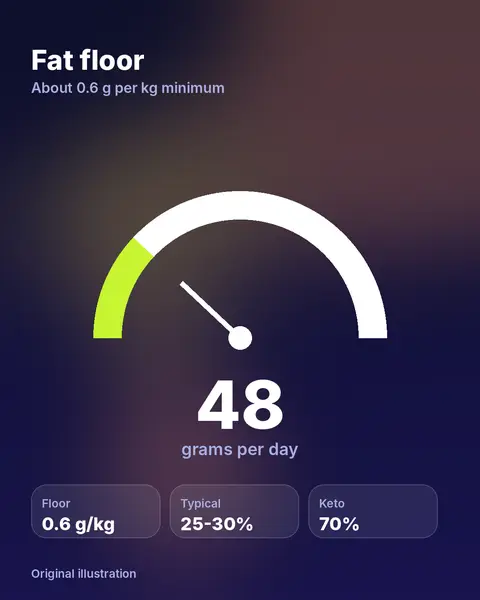
Choose 25-30% of calories, with a floor of about 0.6 g per kg of body weight. Divide the fat calories by 9 to get grams.
Step 6: Carbs
carb calories = total calories − protein calories − fat calories, then divide by 4 for grams.
A complete worked example
Maya, 32, 168 cm (5 ft 6 in), 68 kg (150 lb), moderate activity, wants to lose fat at 0.5% per week.
| Step | Working | Result |
|---|---|---|
| BMR | 10×68 + 6.25×168 − 5×32 − 161 | 1,409 kcal |
| TDEE | 1,409 × 1.55 | 2,184 kcal |
| Deficit | 68 × 0.005 × 7,700 ÷ 7 | −374 kcal |
| Target calories | 2,184 − 374 | 1,810 kcal |
| Protein | 2.0 g × 68 kg | 136 g = 544 kcal |
| Fat | 28% × 1,810 ÷ 9 | 56 g = 504 kcal |
| Carbs | (1,810 − 544 − 504) ÷ 4 | 190 g |
Check: 544 + 504 + 760 = 1,808 kcal. Close enough; rounding explains the 2 kcal gap. Now type the same details into the macro calculator and compare. You should land within a few calories and grams.
Checking your work with the calculator
- If your hand result and the tool differ by more than 5%, check unit conversions first.
- The tool also applies a 1,200 kcal floor for women and 1,500 kcal for men, and caps protein at 40% of calories. Your hand maths will not do that unless you add it.
- Use the Equations tab to see Harris-Benedict and lean-mass answers side by side.
Converting between grams, calories and percentages
| You have | To get | Do this |
|---|---|---|
| Grams | Calories | protein/carbs × 4, fat × 9 |
| Calories and a % split | Grams | (calories × %) ÷ 4 or ÷ 9 |
| Grams | % of calories | (g × 4 or 9) ÷ total calories × 100 |
Use the macro percentage calculator and the macro to calorie calculator for instant conversions.
Original data: how sloppy inputs distort results
Using Maya's profile, we changed one input at a time and recalculated her maintenance calories. Moving from "moderate" (1.55) to "very active" (1.725) added 246 kcal to her daily target, more than any other single mistake. Entering weight 5 kg too high added about 78 kcal; entering height 5 cm too tall added about 48 kcal. The activity multiplier is the input most worth being honest about.
Our take: what is overrated, underrated and wrong
Choosing between Mifflin and Harris-Benedict. The gap is usually 50-120 kcal, smaller than your day-to-day intake error.
A kitchen scale and a weekly average weight. Good data beat a perfect equation.
Using a percentage split blindly. 40/30/30 means very different grams at 1,400 and 3,000 calories.
Troubleshooting your numbers
- Result below 1,200 (women) or 1,500 (men): your pace is too aggressive or your activity is set too low.
- Protein looks huge: you may be using total weight at a high BMI; use a lean-mass or adjusted reference.
- Carbs under 50 g on a non-keto plan: lower the deficit or raise fat toward 30%.
- Weight not changing after 3 weeks: adjust calories by 100-150 kcal. See why macros may not work.
Who needs to know how to calculate macros?
Anyone who wants to know why a target is what it is, not just copy one. If you track food, change goals or follow a coach's plan, knowing how to calculate macros lets you adjust it yourself when life changes.
The macro calculator does the arithmetic instantly; the steps above show what it is doing.
FAQ
How do I calculate my macros for weight loss?
Find maintenance calories, subtract a deficit (about 15-25%), set protein at 1.6-2.2 g/kg, fat at 25-30% of calories and give the rest to carbs.
How do I calculate macros from calories?
Multiply calories by each macro's percentage, then divide by 4 (protein, carbs) or 9 (fat) to get grams.
How do I calculate macros in lb instead of kg?
Divide pounds by 2.2046 to get kilograms, then use the formulas above. Or use 0.7-1.0 g of protein per lb of body weight as a shortcut.
What is the macro formula?
There is no single formula: it is a sequence. BMR, then TDEE, then goal calories, then protein, fat and carbs.
Are online calculators accurate?
They are good starting points. Real energy needs vary, so confirm the result with two to three weeks of weight data.
Should I eat the same macros every day?
You can. Many people prefer weekly averages with some flexibility, and a few use carb cycling. Either approach works.
Sources
- Mifflin MD, et al. Am J Clin Nutr. 1990;51(2):241-247.
- Katch FI, McArdle WD. Nutrition, Weight Control and Exercise. 1977.
- Roza AM, Shizgal HM. The Harris Benedict equation reevaluated. Am J Clin Nutr. 1984;40(1):168-182.
- Hall KD, et al. Lancet. 2011;378(9793):826-837.
- Institute of Medicine. DRI for Macronutrients. 2005.
Keep going
What Are Macros?
Protein, carbs and fat explained simply.
Macro Percentage Calculator
Turn a calorie target and percentage split into grams.
Macro to Calorie Calculator
Convert grams of macros to calories and percentages.
Weight Loss Macro Calculator
Pace-based deficit with protein that protects muscle.
IIFYM Calculator
Flexible dieting macros and guardrails.
Not Losing Weight on Macros?
Seven reasons and a two-week test.