Updated November 3, 2026 · 5 min read · Sources listed at the end
A macro percentage calculator converts a split such as 40/30/30 into grams of protein, carbs and fat for your calorie target.
What a macro percentage actually tells you
Definition
A macro percentage is the share of daily calories that comes from protein, carbohydrate and fat. To turn it into grams, multiply calories by the percentage and divide by the energy in one gram: 4 kcal for protein and carbohydrate, 9 kcal for fat.
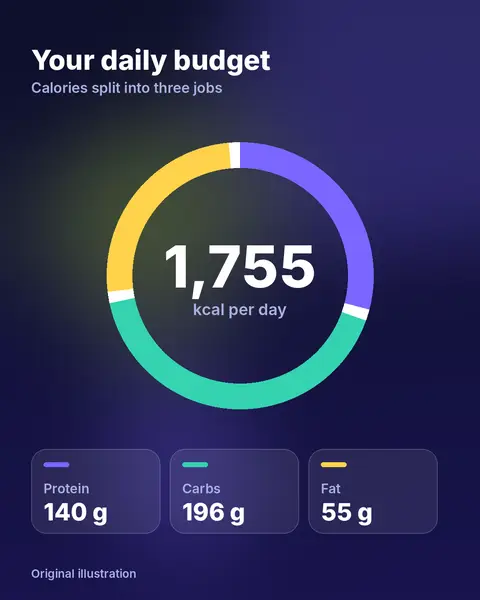
The three percentages must add up to 100. A diet of 2,000 kcal at 30% protein, 40% carbohydrate and 30% fat works out like this:
- Protein: 2,000 × 0.30 ÷ 4 = 150 g
- Carbohydrate: 2,000 × 0.40 ÷ 4 = 200 g
- Fat: 2,000 × 0.30 ÷ 9 = 67 g
Grams are what end up on a food log or a plate, which is why a percentage is only a stepping stone. The calculator above does the conversion in one step and flags splits that do not total 100.
How to use the macro percentage calculator in four steps
- Start with a calorie target. If it is unknown, the TDEE calculator or the main free macro calculator will give one.
- Choose a split. Pick a preset or type three percentages that total 100.
- Read the grams. Protein, carbohydrate and fat appear in grams, with the calories each one contributes.
- Check protein against body weight. Divide protein grams by weight in kilograms. Between about 1.6 and 2.2 g/kg suits most active adults.
Common macro splits and what they look like in grams
The table below applies each split to 2,000 kcal, so the grams can be compared directly.
| Split (P / C / F) | Protein | Carbs | Fat | Typical use |
|---|---|---|---|---|
| 30 / 40 / 30 | 150 g | 200 g | 67 g | Balanced fat loss |
| 25 / 50 / 25 | 125 g | 250 g | 56 g | Active, muscle gain |
| 35 / 30 / 35 | 175 g | 150 g | 78 g | Higher-protein cut |
| 20 / 55 / 25 | 100 g | 275 g | 56 g | Endurance training |
| 20 / 5 / 75 | 100 g | 25 g | 167 g | Ketogenic |
The Institute of Medicine sets the acceptable macronutrient distribution ranges for adults at 10 to 35% of calories from protein, 45 to 65% from carbohydrate and 20 to 35% from fat. Most of the splits above sit inside those ranges. The keto row is the exception, and it is a deliberate one: ketosis depends on very low carbohydrate, not on staying inside the general range. The keto macro calculator handles that case with net carbs.
Why percentages mislead, and the grams-first fix
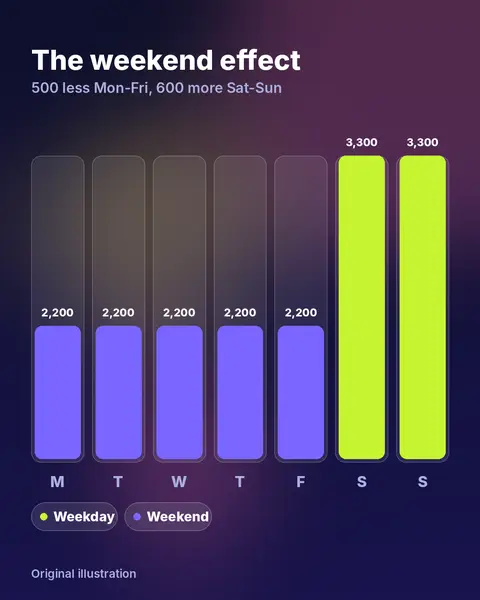
A percentage is a share of a number that changes from person to person. At 1,400 kcal, 30% protein is 105 g. At 3,000 kcal, 30% protein is 225 g. A 60 kg woman on the first plan eats 1.75 g/kg, which is a sound figure. A 70 kg person on the second would eat 3.2 g/kg, far beyond what research shows is useful.
Percentages also move when calories move. Someone who cuts from 2,400 to 1,800 kcal while keeping a 30% protein share loses 45 g of protein without noticing, at the point where protein matters most.
The grams-first method avoids both problems:
- Set protein from body weight, roughly 1.6 to 2.2 g/kg depending on goal.
- Set a fat floor, around 0.6 to 0.8 g/kg, so hormones and vitamin absorption are supported.
- Fill the remaining calories with carbohydrate.
- Convert the result back to percentages only if a tracking app asks for them.
Original data: one 70 kg person, 2,200 kcal, two methods
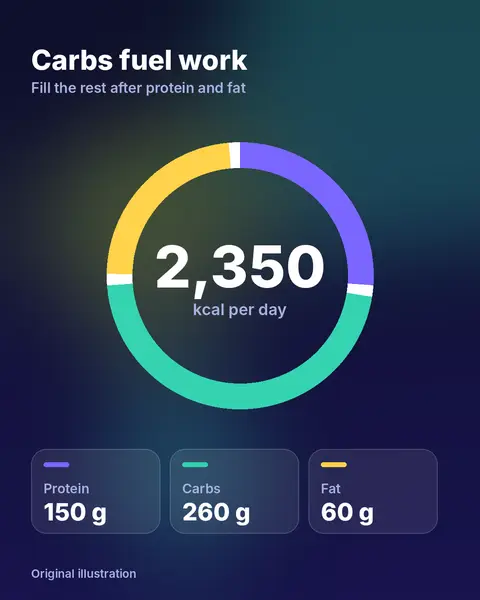
By the percentage method, a 30 / 40 / 30 split gives 165 g protein, 220 g carbs and 73 g fat. By the grams-first method, 1.8 g/kg protein (126 g), 0.9 g/kg fat (63 g) and the rest as carbohydrate (about 282 g) gives a split of roughly 23 / 51 / 26. The grams-first plan leaves about 62 g more carbohydrate for training and keeps protein inside the evidence-based range without forcing it up to 2.4 g/kg.
Choosing a split that fits the goal
- Fat loss. Higher protein (30 to 35%) keeps fullness up and protects muscle while calories are lower. Carbohydrate takes whatever remains after fat.
- Muscle gain. Moderate protein (25 to 30%), more carbohydrate (45 to 55%) for training volume, and fat near 25%.
- Endurance training. Carbohydrate leads, often 55 to 65% on heavy days, with protein at 15 to 20%.
- Keto. Fat 70 to 75%, protein 20 to 25%, carbohydrate under about 5% of calories or 20 to 50 g net.
When in doubt, the macro calculator for weight loss and the muscle gain version set protein in grams first, then fill the rest.
A quick way to sanity-check any split
Take the protein grams and divide by body weight in kilograms. Under 1.2 g/kg is low for someone training, over 2.4 g/kg is more than most people need, and anything between sits in the practical zone. Then check the fat grams against 0.6 g/kg as a floor. If both pass, the rest of the split is a matter of preference.
Common mistakes with macro percentages
- Rounding to neat numbers. 33 / 33 / 33 sums to 99, and a 1% gap is 20 kcal at 2,000 kcal.
- Dividing fat by 4. Fat carries 9 kcal per gram, so dividing a fat percentage by 4 doubles the grams.
- Counting alcohol as nothing. Alcohol supplies 7 kcal per gram. The macro to calorie calculator includes it.
- Copying a friend's split. A friend's percentage reflects their calories and body size, not yours.
Our take: what is overrated, underrated and wrong
Fixed splits such as 40/40/20 as a universal answer. They are fine starting points, but they were never calibrated to individual body weight.
Protein grams per kilogram. It scales correctly with body size and does not change when calories do.
The belief that the exact percentage matters more than total calories and protein. Within reasonable limits, calories and protein decide most of the outcome.
FAQ
How do I calculate macros from percentages?
Multiply daily calories by each percentage, then divide by 4 for protein and carbohydrate or by 9 for fat. For 2,000 kcal at 30% fat, that is 2,000 × 0.30 ÷ 9 = 67 g.
What is a good macro split?
It depends on the goal. A balanced 30 / 40 / 30 suits many people, but protein in grams per kilogram is the more reliable anchor.
Do the percentages need to add up to 100?
Yes. The calculator warns when they do not.
Is 40 / 40 / 20 a good split?
It is a classic bodybuilding-style split and works if the protein it produces lands near 1.6 to 2.2 g/kg and fat stays above a sensible floor.
Should I use percentages or grams?
Grams of protein first, then percentages for carbohydrate and fat if a simple guide is needed.
Can I convert grams back to percentages?
Yes. Multiply each gram value by its kcal per gram, add them, then divide each result by the total. The macro to calorie calculator does this.
Sources
- Institute of Medicine. Dietary Reference Intakes for Energy, Carbohydrate, Fiber, Fat, Fatty Acids, Cholesterol, Protein, and Amino Acids. 2005.
- Jäger R, et al. ISSN position stand: protein and exercise. J Int Soc Sports Nutr. 2017;14:20.
- Morton RW, et al. A systematic review, meta-analysis and meta-regression of the effect of protein supplementation on resistance training-induced gains in muscle mass and strength. Br J Sports Med. 2018;52:376-384.
Keep going
Macro to Calorie Calculator
Convert grams of macros to calories and percentages.
IIFYM Calculator
Flexible dieting macros and guardrails.
What Are Macros?
Protein, carbs and fat explained simply.
How to Calculate Macros
The six-step maths with a worked example.
Weight Loss Macro Calculator
Pace-based deficit with protein that protects muscle.
Keto Macro Calculator
Net-carb cap first, protein second, fat fills the rest.