Updated November 3, 2026 · 4 min read · Sources listed at the end
This macro calculator for men sets calories and macros from size, training and goal. A macro calculator men can rely on needs a sensible protein figure, a realistic deficit or surplus and room for training; the sections below explain how each one is chosen and how to adjust after the first two or three weeks.
Macro targets for men: what changes
Definition
A macro calculator for men uses the male form of the resting-energy equation (+5 instead of −161 in Mifflin-St Jeor), and typically returns higher calories and protein because men on average have more lean mass and larger bodies.
The extra calories are mostly about muscle. Lean tissue burns more energy at rest, which is why two people of the same weight can have very different maintenance calories if one carries more muscle. If you know your body-fat percentage, enter it above and the tool switches to Katch-McArdle, which accounts for that difference directly.
Example targets for men
Outputs from this calculator, balanced split, so you can compare with your own.
| Profile | Maintenance | Goal | Calories | P / C / F |
|---|---|---|---|---|
| 30 y, 180 cm, 80 kg, moderate | 2,759 | Maintain | 2,759 | 128 / 369 / 86 g |
| 30 y, 180 cm, 80 kg, moderate | 2,759 | Lose at 0.5%/wk | 2,319 | 160 / 257 / 72 g |
| 40 y, 175 cm, 90 kg, desk life | 2,159 | Lose at 0.5%/wk | 1,664 | 164 / 136 / 52 g |
| 22 y, 185 cm, 78 kg, very active | 3,159 | Novice muscle gain | 3,359 | 140 / 465 / 105 g |
| 60 y, 170 cm, 82 kg, light | 2,183 | Maintain | 2,183 | 122 / 271 / 68 g |
Three male-specific considerations
1. The desk-job trap
Many men who lift three times a week still sit for nine hours. That is "light" or "moderate" at best. Picking "very active" because you train hard inflates calories by 10-15% and stalls fat loss.
2. Belly fat and body-fat accuracy
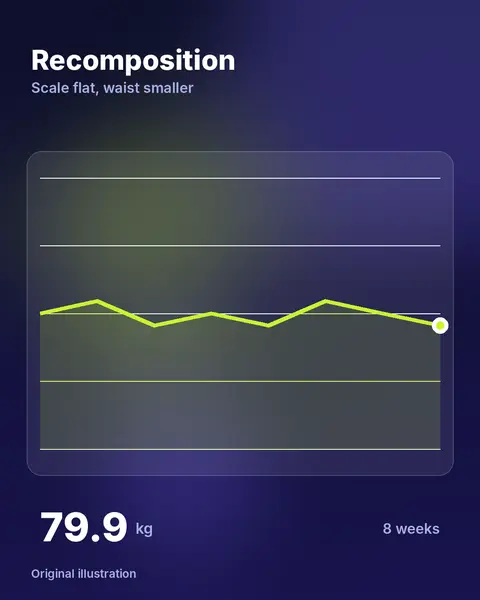
Men tend to store fat around the abdomen. A tape measure at the navel is a better progress tracker than weight for many men. Use the same spot and time each week.
3. Muscle matters more as you age
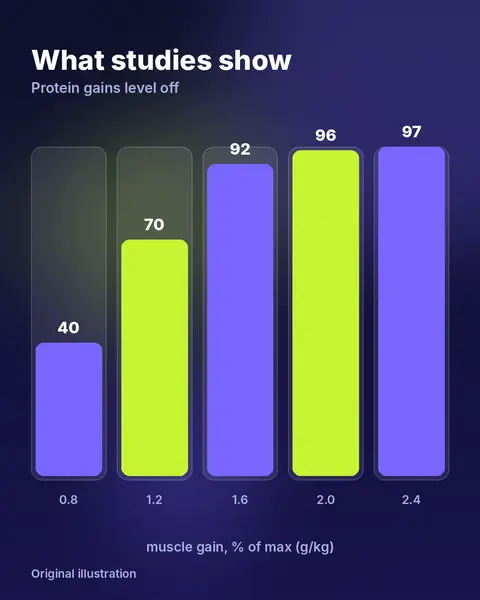
From about age 30, adults can lose muscle gradually unless they train and eat enough protein. For men over 40, a protein target near 1.6-2.0 g/kg with regular resistance training is a sound default.
Fat loss for men: a simple plan
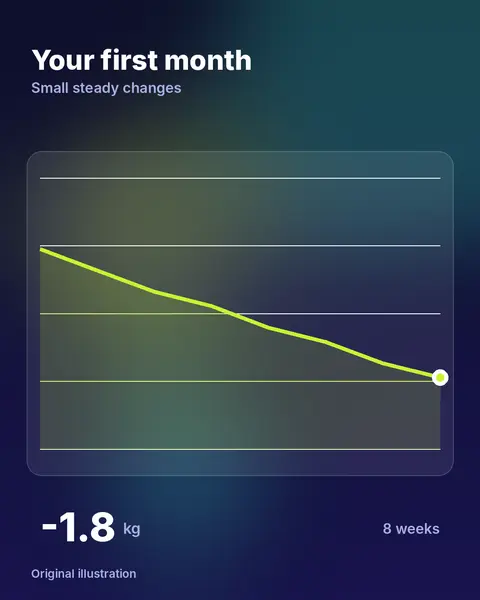
- Start at a 0.5% pace and keep protein near 2.0 g/kg.
- Lift three or four times a week. Keep weights heavy while calories are lower.
- Walk 8,000-10,000 steps most days.
- Weigh in daily, judge weekly, and adjust only when the average is off pace for two weeks.
Muscle gain for men: a simple plan
Pick your experience level in the Build muscle goal. Beginners can gain about 1.5% of body weight per month; advanced lifters about 0.25%. For an 80 kg man the difference is about 1.2 kg versus 0.2 kg per month. Pair the surplus with a progressive programme and 7-9 hours of sleep.
What the research says
- Protein for lifters. The International Society of Sports Nutrition position stand recommends 1.4-2.0 g/kg per day for most exercising adults (Jager et al., 2017).
- Equation accuracy. Mifflin-St Jeor is the best-performing predictor among the common equations according to a systematic review by Frankenfield et al. (2005).
- Age and muscle. Muscle mass declines roughly 3-8% per decade after 30 in sedentary adults, so resistance training and protein matter more with every decade.
Original data: how lean mass changes the answer
A 100 kg man, 175 cm, 40 years old, moderate activity. Using Mifflin-St Jeor only, his BMR is 1,899 kcal. If he also enters 28% body fat (72 kg lean mass), Katch-McArdle gives 1,925 kcal. If he has 15% body fat (85 kg lean mass), Katch-McArdle gives 2,206 kcal, about 280 kcal more resting energy than the 28% case at identical body weight. That is why body fat, when you know it, improves the estimate for people at the extremes.
Our take: what is overrated, underrated and wrong
Testosterone boosters and complex supplement stacks. Sleep, protein and heavy lifting do the work.
Steps. Many men can lose fat by walking an extra 3,000 steps a day without reducing food further.
Using 1 g of protein per pound of body weight at 300 lb. A 300 lb man does not need 300 g; use lean mass or a target weight.
FAQ
How many calories should a man eat per day?
Typical maintenance for adult men ranges from about 2,200 to 3,200 kcal depending on size and activity. The calculator gives you your own figure.
How much protein does a man need?
For fat loss and muscle gain, about 1.6-2.2 g per kg (0.7-1.0 g per lb) is a practical range.
How many macros for a 200 lb man?
It depends on height, age, activity and goal. For a 200 lb (91 kg) moderately active man cutting at 0.5% a week, expect roughly 2,400 kcal with about 170 g protein.
Does age change the macro split?
Calories tend to drop with age and protein needs rise slightly. The split itself remains flexible.
Should men eat more carbs or fat?
Either works. Most lifters feel better with plenty of carbs; some men prefer a lower-carb, higher-fat style. Choose the one you can sustain.
Sources
- Mifflin MD, et al. Am J Clin Nutr. 1990;51(2):241-247.
- Frankenfield D, et al. J Am Diet Assoc. 2005;105(5):775-789.
- Jager R, et al. J Int Soc Sports Nutr. 2017;14:20.
- Volpi E, Nazemi R, Fujita S. Muscle tissue changes with aging. Curr Opin Clin Nutr Metab Care. 2004;7(4):405-410.
Keep going
Muscle Gain Macro Calculator
Lean-bulk surplus by training experience.
Weight Loss Macro Calculator
Pace-based deficit with protein that protects muscle.
Bodybuilding Calculator
Lean-mass bulk and cut macros.
Body Recomp Calculator
Maintenance calories, high protein, smart carb cycling.
IIFYM Calculator
Flexible dieting macros and guardrails.
Keto Macro Calculator
Net-carb cap first, protein second, fat fills the rest.