Updated November 3, 2026 · 5 min read · Sources listed at the end
A calorie deficit calculator shows how many calories to cut to lose weight at a pace you can keep, and when you should reach your goal. Planning exercise too? Use the calories burned calculator to see what a workout adds.
What is a calorie deficit?
Definition
A calorie deficit means eating fewer calories than you burn (your TDEE). The body makes up the difference from stored energy, mostly body fat, so weight falls over time.
About 7,700 kcal corresponds to 1 kg of body mass change, a widely used approximation (about 3,500 kcal per lb). Real results vary because water, glycogen and muscle change too, and metabolism adapts as you lose weight (Hall et al., 2011).
For a second opinion on pace and time to goal, compare your result with the NIH Body Weight Planner.
How large should the deficit be?
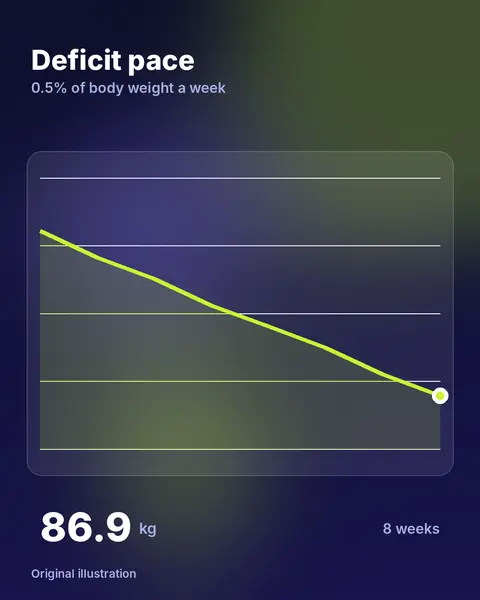
The calculator sets the deficit as a percentage of body weight lost per week, which scales safely with size:
| Pace | Typical use | Notes |
|---|---|---|
| 0.25% per week | Gentle, long diets, lean people | Best muscle retention |
| 0.5% per week | Standard | Good balance of speed and sustainability |
| 0.75% per week | Faster | Needs high protein and sleep |
| 1% per week | Maximum | Short phases only |
Example, 90 kg man, 180 cm, 35, moderate activity, TDEE 2,875:
| Pace | Daily calories | Deficit | Weekly loss |
|---|---|---|---|
| 0.25% | 2,628 | 247 | 0.23 kg |
| 0.5% | 2,380 | 495 | 0.45 kg |
| 0.75% | 2,133 | 742 | 0.68 kg |
| 1% | 1,885 | 990 | 0.9 kg |
Safety limits built into the tool
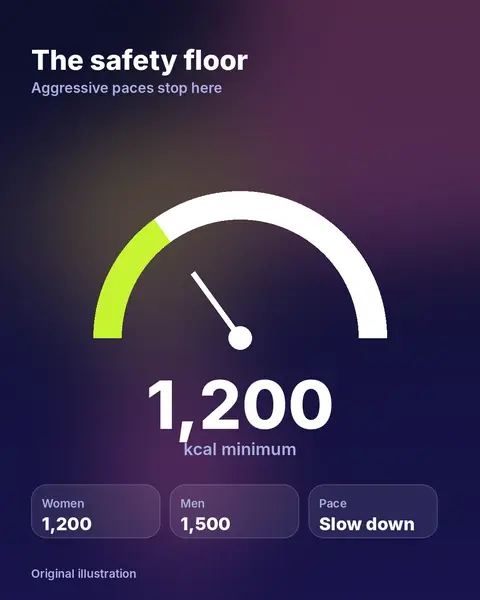
- Calories never go below 1,200 (women) or 1,500 (men) without a warning.
- Deficits are capped at 35% of maintenance.
- Paces above 1% per week trigger a warning.
- Protein is capped at 40% of calories.
Very low calorie diets should only be used under medical supervision.
Why your progress may not match the maths
Weight is not fat. Water retention, hormones, sodium and food in the gut can mask 1-2 kg either way. Use weekly averages. If three to four weeks pass with no change in the average, check logging before cutting calories. See macros not losing weight.
Original data: bigger is not faster for long
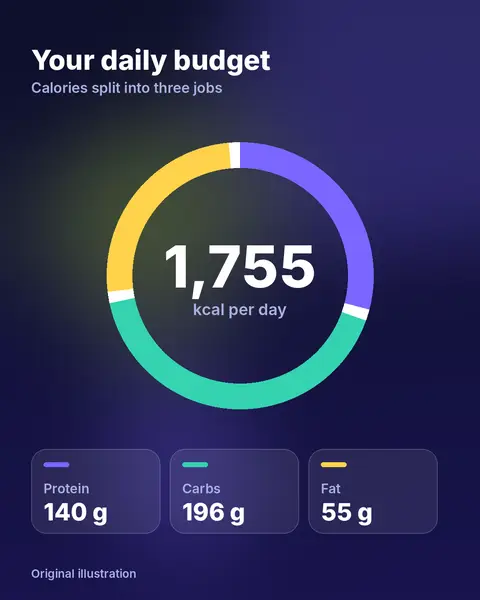
A 70 kg woman choosing 1%/week gets only 1,247 kcal a day on the calculator, while 0.5% gives 1,533. The faster plan loses 0.7 kg a week in theory, but the protein cap of 40% of calories already forces her protein from 140 g down to 125 g, and calories that low are hard to keep up. The standard pace usually wins on adherence.
How to use the calorie deficit calculator in four steps
- Enter body details and activity so maintenance calories are estimated.
- Pick a weekly pace or a target weight and date. The calculator converts either one into a daily number.
- Read the daily calories, the deficit and the expected weekly change.
- Check the safety messages. If the tool adds a warning, the pace or date is too aggressive for the body entered.
Why a percentage beats a fixed number
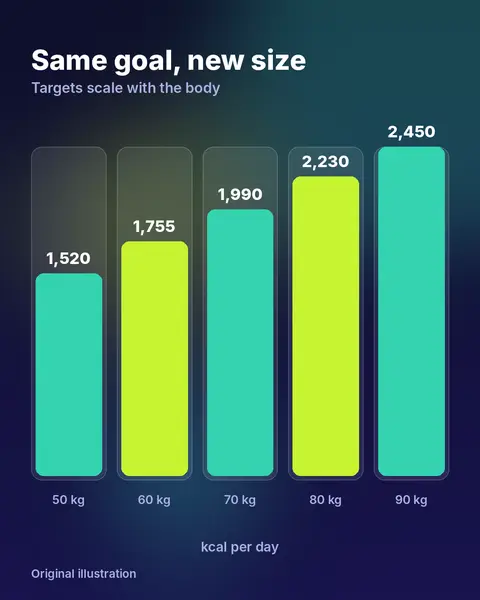
The classic "cut 500 calories" rule came from a rough conversion: 500 kcal a day times 7 days is 3,500 kcal, or about one pound of fat. It works as a first guess for an average adult. It breaks down at the edges. For a 55 kg woman with maintenance near 1,700 kcal, a 500 kcal cut is a 29% deficit, steep enough to hurt training and sleep. For a 110 kg man at 3,200 kcal, the same cut is only 16%, and he will probably lose slowly. A percentage of body weight per week scales to both.
What research says about how fast to lose
Garthe and colleagues (2011) followed elite athletes who cut weight either slowly (about 0.7% of body weight a week) or fast (about 1.4%). The slow group gained lean mass and strength while losing fat. The fast group lost fat too but did not gain lean mass. Helms and colleagues (2014) recommend 0.5 to 1% of body weight per week for lean, trained people, and slower paces as body fat gets lower. Hall and colleagues (2011) modelled why the maths drifts: as body weight falls, maintenance falls with it, so a fixed calorie cut yields a shrinking deficit over time.
What a "good" 12 weeks looks like
A 90 kg person at 0.5% a week should be near 85 kg after 12 weeks, give or take a kilogram of water. Along the way, 2 to 3 weeks of flat scale readings are normal and are not a reason to cut calories. A steady waist measurement, rising or flat gym numbers and decent sleep are the signs the plan is working.
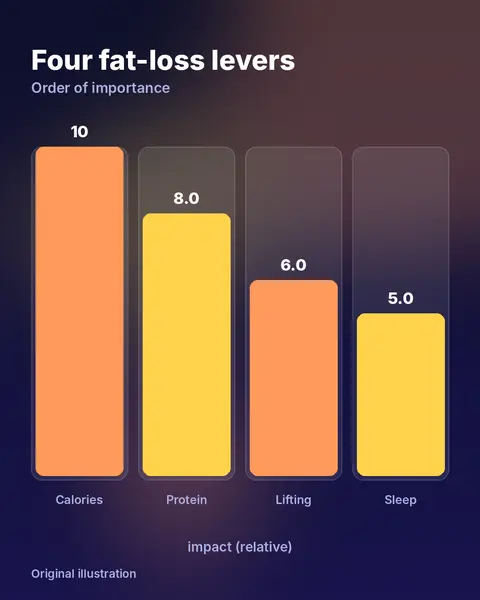
Diet breaks and maintenance phases
Long deficits get harder. In the MATADOR trial (Byrne et al., 2018), people who alternated two weeks of dieting with two weeks at maintenance lost more fat over time than people who dieted continuously, with less loss of resting metabolic rate. The finding comes from a modest sample, but it supports planned breaks every 8 to 12 weeks, especially at a lean body weight.
Our take: what is overrated, underrated and wrong
Fixed "1,200 calorie" diets for everyone.
Diet breaks of 1-2 weeks at maintenance after long deficits.
Cutting calories further after two weeks without checking logging accuracy.
FAQ
How many calories should I cut to lose weight?
Around 10-25% below maintenance, or 0.25-0.75% of body weight per week. The calculator does this for your size.
How big a calorie deficit is safe?
A deficit that keeps you above 1,200-1,500 kcal and loses under 1% of body weight a week is generally considered safe for healthy adults.
Is a 500-calorie deficit right for everyone?
No. 500 kcal is a rule of thumb. It is big for a small woman and small for a large man.
How long to lose 10 kg?
At 0.5% a week for an 80 kg person (0.4 kg a week) about 25 weeks. Faster is possible but harder to keep.
Do I need to count macros in a deficit?
Calories drive weight loss; protein protects muscle. See the macro calculator.
Is a 500-calorie deficit always right?
No. It is a 29% deficit for a small woman and 16% for a large man. A percentage of body weight is more reliable.
Do I need a diet break?
After 8 to 12 weeks, or when energy, sleep and training suffer, a week or two at maintenance can help. It is optional for short, gentle cuts.
Why did my weight stop dropping?
Water shifts, a smaller body that burns less, and logging drift are the usual reasons. Check the four-week average before changing anything.
Sources
- Hall KD, et al. Quantification of the effect of energy imbalance on bodyweight. Lancet. 2011;378:826-37.
- Wishnofsky M. Caloric equivalents of gained or lost weight. Am J Clin Nutr. 1958.
- Helms ER, et al. J Int Soc Sports Nutr. 2014;11:20.
Keep going
TDEE Calculator
Maintenance calories and targets for each goal.
Weight Loss Macro Calculator
Pace-based deficit with protein that protects muscle.
Not Losing Weight on Macros?
Seven reasons and a two-week test.
Protein Calculator
Daily protein in grams for your goal.
Intermittent Fasting Calculator
Per-meal macros for any eating window.
How to Calculate Macros
The six-step maths with a worked example.