Updated November 3, 2026 · 6 min read · Sources listed at the end
This macro calculator for weight loss sets a calorie deficit sized to body weight, then fixes protein, fat and carbohydrate around it. A macro calculator for fat loss works best when the pace is gentle and protein is high, so the sections below cover the deficit, the protein target, a realistic timeline and what to do when progress slows. Women who search for a macro calculator for weight loss female get the same engine, with the safer calorie floor applied automatically. Planning exercise too? Use the calories burned calculator to see what a workout adds.
How a weight loss macro calculator works
Definition
A weight loss macro calculator subtracts a calorie deficit from your maintenance calories, then assigns most of what is left to protein first, fat second and carbohydrate last, so you lose body fat while holding on to as much muscle as possible.
The word that matters is as much as possible. Scale weight is a blend of fat, muscle, water and gut contents. A deficit that is too deep, protein that is too low, or no resistance training at all will pull more of that blend from muscle. The settings above are chosen to tilt the balance the other way.
Three inputs do most of the work:
- Maintenance calories (TDEE). Your estimated daily burn, from the Mifflin-St Jeor or lean-mass equation times your activity level.
- Pace. How fast you want to lose, expressed as a percentage of your body weight per week. This is more honest than a flat "500 calorie deficit", because 500 kcal is a big cut for a small person and a rounding error for a large one.
- Protein. Set from body weight (or lean mass if you enter body fat) and raised during a deficit.
What pace should you choose?
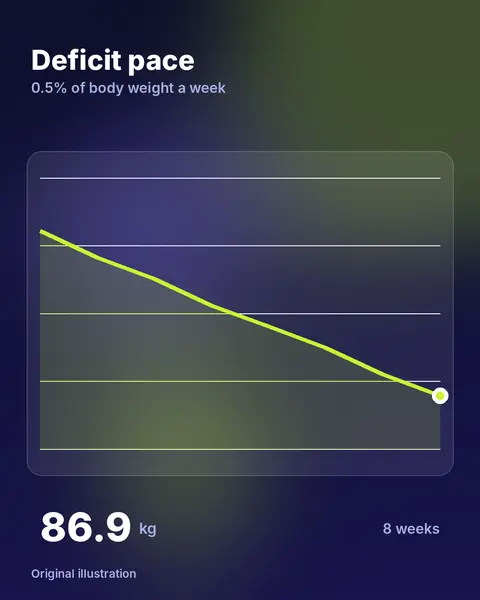
The pace slider runs from 0.1% to 1.5% of body weight per week. Here is what each part of that range feels like, using a 62 kg (137 lb) woman at light activity and an 80 kg (176 lb) man at moderate activity, both calculated with this tool.
| Weekly pace | Woman 62 kg: calories | Man 80 kg: calories | Pace in lb per week (80 kg) | Feel |
|---|---|---|---|---|
| 0.25% | 1,672 | 2,539 | 0.4 | Barely noticeable, very sustainable |
| 0.5% | 1,502 | 2,319 | 0.9 | The default: steady and flexible |
| 0.75% | 1,331 | 2,099 | 1.3 | Brisk, needs planning |
| 1.0% | 1,200 (floor) | 1,879 | 1.8 | Hard, short bursts only |
Notice the last cell in the woman's column. At a 1% pace her calculated intake would fall under 1,200 kcal, so the tool lifts it to the floor and tells you so. That is the safety logic doing its job.
A realistic timeline
At 0.5% a week, an 80 kg person loses roughly 0.4 kg every seven days, so a 10 kg goal takes about 25 weeks. At 0.75% it takes about 17 weeks, and at 1% about 13. Plan for the slower number, then enjoy finishing early. Most plans fail from burnout in month two, not from being too gentle.
Target-date mode
Prefer working backwards from an event? Switch to Set a target date, enter your goal weight and the number of weeks, and the tool converts that into a pace. If it comes out above 1% of body weight per week, you will see a warning and the deficit is capped at 35% of maintenance. Use that warning as information: either extend the date or shrink the goal.
Your protein, fat and carb targets
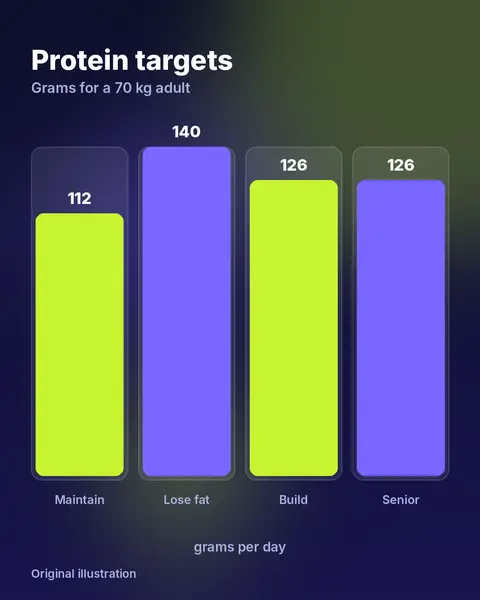
Protein is the one macro you should protect when calories fall. The defaults here are about 2.0 g per kg of body weight (0.9 g per lb) in a deficit, and about 2.4 g per kg of lean mass when you enter body fat. For people with a high BMI and no body-fat figure, the tool uses an adjusted reference weight, so a 110 kg person is not told to eat 220 g of protein.
Fat is set near 28% of calories and never allowed under about 20%, because very low fat intakes can interfere with hormones and the absorption of vitamins A, D, E and K. Carbohydrate takes whatever remains, which is why carbs fall fastest as your pace increases:
| Man 80 kg, balanced split | Protein | Carbs | Fat |
|---|---|---|---|
| Maintenance (2,759 kcal) | 128 g | 369 g | 86 g |
| 0.5% pace (2,319 kcal) | 160 g | 257 g | 72 g |
| 1.0% pace (1,879 kcal) | 160 g | 178 g | 58 g |
Protein rises when the deficit starts and then stays put. That is deliberate: the amount you need to protect muscle goes up as energy goes down.

Your first three weeks, step by step
- Week 0: calculate, then write down protein, calories and a plan for breakfast and lunch. Weigh food on a kitchen scale; it takes about 20 seconds a meal.
- Week 1: hit the numbers, ignore the scale's verdict. Water and glycogen can move your weight by 1-3 lb either way when carbs change.
- Weeks 2-3: weigh yourself daily, record the weekly average, and compare it with your pace. Then open the Check-in tab above and enter the difference. It suggests a change in 10 kcal steps, capped at 400 kcal.
- After week 3: if the average is on pace, change nothing. Hold the plan for another two weeks before any adjustment.
Our take: what is overrated, underrated and wrong
Cutting carbs for their own sake, "clean eating" rules, and the first-week scale drop. Early rapid loss is mostly water.
Walking. An extra 3,000 steps a day costs almost no recovery and can add roughly 100-150 kcal of burn, which is a fat-loss lever that does not touch your food.
Dropping below your calorie floor to "speed things up", and doing cardio-only dieting without lifting or protein. You end up smaller but softer.
Common weight loss macro mistakes
- Starting at the most aggressive pace. Begin at 0.5% and tighten only if you have to.
- Cutting protein to afford more carbs. Protein is the most satiating macro; shrinking it makes dieting harder, not easier.
- Forgetting liquid calories. Two lattes and a juice can quietly equal 400 kcal.
- Weekend drift. Five perfect days and two loose ones can erase a 500-kcal daily deficit. Track weekends too.
- Using the calculator as a verdict. It is a hypothesis you test for three weeks.
FAQ
How many calories should I eat to lose weight?
Eat below your maintenance calories by an amount that matches your chosen pace. For most adults that is a deficit of about 15-25% of maintenance. The calculator works it out from your body weight and pace, and never goes below 1,200 kcal (women) or 1,500 kcal (men).
What is the best macro split for fat loss?
Prioritise protein (about 2.0 g per kg of body weight), keep fat around 25-30% of calories and let carbs fill the rest. If you prefer fewer carbs, move to the lower-carb style; the fat-loss result is driven by calories, not by the split.
How fast should I lose weight?
Between 0.5% and 0.75% of body weight per week suits most people. Faster than 1% a week raises the odds of muscle loss, fatigue and rebound eating.
Do I need to count macros forever?
No. Many people track strictly for 8-12 weeks, learn what their portions look like, then switch to tracking protein only or tracking a few days per week.
Why did my weight stop dropping?
As you get lighter your maintenance calories fall, and your body adapts a little. Check adherence first, then use the Check-in tab to reduce calories by 100-150 kcal, or take a one-to-two-week break at maintenance.
Should I eat back exercise calories?
Not if you picked an activity level that already includes your workouts, which is how this calculator works. Eating them back counts the same exercise twice.
Can I use this while breastfeeding or pregnant?
No. Energy and nutrient needs change in pregnancy and lactation, and weight loss should be directed by your clinician.
Sources
- Garthe I, et al. Int J Sport Nutr Exerc Metab. 2011;21(2):97-104. Two different weight-loss rates in elite athletes.
- Helms ER, Zinn C, Rowlands DS, Brown SR. A systematic review of dietary protein during caloric restriction in resistance trained lean athletes. Int J Sport Nutr Exerc Metab. 2014;24(2):127-138.
- Hall KD, et al. Quantification of the effect of energy imbalance on bodyweight. Lancet. 2011;378(9793):826-837.
- Mifflin MD, et al. Am J Clin Nutr. 1990;51(2):241-247.
- U.S. Department of Agriculture and U.S. Department of Health and Human Services. Dietary Guidelines for Americans, 2025-2030.
Related reading: Wondering whether a high-protein split really burns extra? Read about the thermic effect of food and what it is worth per day.
Keep going
How to Calculate Macros
The six-step maths with a worked example.
Carb Cycling Calculator
High and low carb days that average to your target.
Intermittent Fasting Calculator
Per-meal macros for any eating window.
Macro Calculator for Women
Female-first defaults, safe floors and cycle notes.
Food Macro Calculator
Search foods and log against your daily targets.
Not Losing Weight on Macros?
Seven reasons and a two-week test.