Updated November 3, 2026 · 4 min read · Sources listed at the end
This macro calculator bodybuilding athletes can use covers bulking, cutting and the final weeks before a show, with protein set in grams per kilogram and calories adjusted to the phase. The sections below explain each phase, a peak week approach based on published practice and how to avoid the most common bulk and cut mistakes.
Bodybuilding macros: the phase-based approach
Definition
A bodybuilding macro calculator sets calories and macros by training phase: a controlled surplus in the off-season to add muscle, and a progressive deficit in prep to lose fat, with protein anchored to lean body mass.
Bodybuilding is cyclical. A few months of building (bulk) are followed by a few months of shedding fat (cut), and sometimes a maintenance phase in between. Each phase needs different calories, but the protein, training and sleep stay constant.
Building your plan step by step? Start with the macro calculator for muscle gain, set protein with the protein intake calculator and plan the cut with the calorie deficit calculator.
Why lean mass matters
When you know your body-fat percentage, your body is better described as fat mass plus lean mass. Lean mass drives resting energy use and protein needs. The calculator switches to the Katch-McArdle equation once body fat is entered: BMR = 370 + 21.6 × lean mass (kg).
Example: a 28-year-old, 182 cm, 92 kg lifter at 14% body fat has 79.1 kg of lean mass. Katch-McArdle puts his BMR at 2,079 kcal, and at the very active multiplier (1.725) maintenance is about 3,586 kcal.
| Phase | Calories | Protein | Carbs | Fat |
|---|---|---|---|---|
| Maintenance | 3,586 | 142 g | 503 g | 112 g |
| Off-season lean bulk (intermediate, +0.5%/mo) | 3,704 | 158 g | 509 g | 115 g |
| Contest-style cut at 0.7%/week | 2,878 | 190 g | 328 g | 90 g |
Protein in the bulk is 2.0 g per kg of lean mass; in the cut it is 2.4 g per kg of lean mass.
Bulk phase: rate of gain
- Beginner (under a year): about 1.5% of body weight per month.
- Intermediate: 0.5-1%.
- Advanced: 0.25-0.5%.
A well-run off-season adds half a pound to a pound per week at most for a lean intermediate lifter, usually less. Gaining faster adds mainly fat and lengthens the cut.
Cut phase: protect muscle first
For lean lifters, protein needs rise as body fat falls. Helms and colleagues (2014) suggested 2.3-3.1 g per kg of lean mass during a diet for lean, resistance-trained athletes. Our defaults use 2.4 g/kg of lean mass, a practical compromise for most people. Keep training volume and intensity high; the body keeps muscle that it is challenged to use.
Plan the cut with care:
- Aim for 0.5-1% of body weight per week.
- Take a diet break of one to two weeks at maintenance every 8-12 weeks if the diet is long.
- Keep fat above roughly 0.5-0.6 g per kg of body weight.
- Use the Check-in tab each fortnight.
Carb cycling for bodybuilders
Carb cycling (more carbs on heavy training days, fewer on rest days) is popular because it aligns glycogen with training demands. This calculator supports it: set training days per week and read the Meals tab for training and rest-day numbers. The weekly total remains the same as without cycling.
Meal structure for hypertrophy
- 4-6 meals with 30-50 g of protein each.
- Most carbs around training (before and after).
- Fats lower in the pre-workout meal for easier digestion.
- Fibre and vegetables with at least two meals.
What the research says
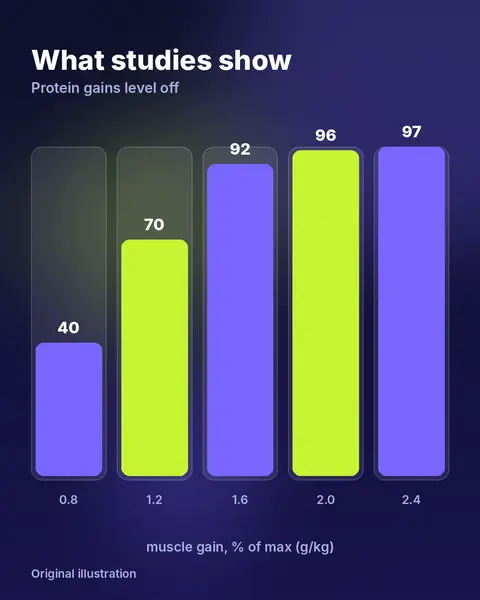
- Protein per kilogram. Meta-analytic work shows muscle-building benefits plateau near 1.6 g/kg (Morton et al., 2018), while lean athletes in a deficit may benefit from more (Helms et al., 2014).
- Rate of loss. Garthe et al. (2011) observed better lean mass outcomes in athletes losing about 0.7% of body weight per week than 1.4%.
- Contest prep. A 12-month case study of a single natural bodybuilder (Rossow et al., 2013) documented large drops in testosterone and body fat across prep and a slow hormonal recovery afterward. One athlete proves little, but it is a sensible reason to keep prep durations moderate and follow them with a proper maintenance phase.
Original data: bulk versus cut at the same body
For the 92 kg lifter above, the engine's gap between the bulk (3,704 kcal) and the cut (2,878 kcal) is 826 kcal a day. Carbs swing 181 g (509 g to 328 g), and protein goes the opposite way, up 32 g (158 g to 190 g). Fat moves only 25 g. In plain terms: from bulk to cut, protein rises, carbs fall and fat barely changes.
Our take: what is overrated, underrated and wrong
Eating every two to three hours for "metabolism." Total protein and calories matter, not meal frequency.
Maintenance phases. Time spent holding weight lets you recover and makes the next bulk or cut more effective.
Bulking to the highest weight possible. "Bigger is better" falls apart when you have to spend six months dieting it off.
FAQ
What are good macros for bodybuilding?
Common targets are 1.6-2.2 g protein per kg (up to 2.4-3.1 g/kg of lean mass when lean and cutting), 20-30% of calories from fat and the rest from carbohydrate.
How many calories to bulk?
Start with maintenance plus about 5-10% for intermediate lifters. Beginners can add more; advanced lifters less.
How should I cut for a show?
Lose 0.5-1% of body weight per week, keep protein high, lift heavy and take diet breaks. Work with an experienced coach for competition prep.
Should I eat the same macros every day?
Not necessarily. Carb cycling is a flexible way to place energy where training happens.
Are 6 meals a day required?
No. Four to five protein-rich meals are practical; the total daily protein matters more than the exact timing.
Sources
- Dietary Guidelines for Americans (USDA and HHS)
- Helms ER, et al. Int J Sport Nutr Exerc Metab. 2014;24(2):127-138.
- Morton RW, et al. Br J Sports Med. 2018;52:376-384.
- Garthe I, et al. Int J Sport Nutr Exerc Metab. 2011;21(2):97-104.
- Rossow LM, et al. Natural bodybuilding competition preparation and recovery: a 12-month case study. Int J Sports Physiol Perform. 2013;8(5):582-592.
- Katch FI, McArdle WD. 1977.
Keep going
Muscle Gain Macro Calculator
Lean-bulk surplus by training experience.
Body Recomp Calculator
Maintenance calories, high protein, smart carb cycling.
Carb Cycling Calculator
High and low carb days that average to your target.
Macro Calculator for Men
Targets by size, training and goal.
IIFYM Calculator
Flexible dieting macros and guardrails.
Best Macro Tracking Apps
How to choose a tracker, with a checklist.