Updated November 3, 2026 · 4 min read · Sources listed at the end
How to read the chart
Definition
Desi food macros are the calories, protein, carbohydrate and fat in South Asian home cooking. Because recipes vary by household, the numbers are typical estimates, not exact values.
Oil and ghee are the main source of variation. A karahi cooked with 1 tablespoon of oil per serving and one cooked with 3 can differ by 240 kcal. Treat the chart as a starting point and adjust if you know how much oil was used.
To log these meals, use the food macro calculator, convert grams to energy with the macro to calorie calculator and read how to calculate macros for the maths behind the targets.
Highest-protein desi dishes
From the chart above, per typical serving:
| Dish | Protein | Calories |
|---|---|---|
| Chicken karahi | 28 g | 320 |
| Chicken curry | 26 g | 260 |
| Chicken tikka | 26 g | 180 |
| Chicken biryani | 24 g | 480 |
| Paneer bhurji | 19 g | 330 |
| Seekh kebab | 18 g | 250 |
Chicken tikka gives the most protein for the fewest calories at about 0.14 g per kcal. Paneer bhurji gives about 0.06 g per kcal, because the fat is heavy.
Daal and chana: protein with carbs
Daal masoor or moong gives 12 g of protein for 205 kcal, and chana daal 13 g for 260 kcal. They are useful, but come with 28-34 g of carbs, so they are not "just protein". For vegetarians they are the base of the day: see the vegetarian macro calculator.
Roti: portion is the lever
One plain roti is about 119 kcal, 3.8 g protein and 22 g carbs. Four rotis at dinner is 476 kcal and 88 g of carbs. Moving from four to two rotis and adding a bigger portion of chicken or daal is the simplest fat-loss change on a desi plate.
Sample high-protein desi day (about 1,800 kcal)
- Breakfast: 2-egg omelette, 1 roti, chai. About 400 kcal, 18 g protein.
- Lunch: chicken curry, 2 rotis, raita. About 570 kcal, 36 g protein.
- Snack: boiled egg and fruit. About 140 kcal, 6 g protein.
- Dinner: chicken tikka, daal masoor, steamed rice. About 580 kcal, 44 g protein.
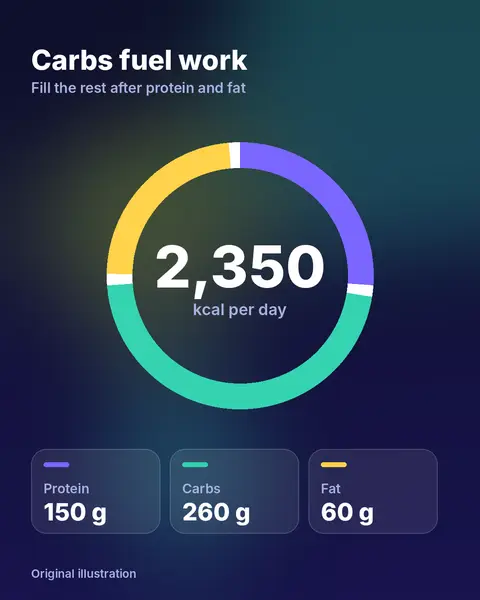
That day totals about 1,690 kcal and 104 g of protein. Add a whey or yogurt snack if your target is higher.
Original data: the biryani effect
A plate of chicken biryani (480 kcal) contains about as many calories as a chicken tikka (180), daal (205) and one roti (119) combined, 504 kcal. The combination has about 42 g of protein vs 24 g. Same energy, nearly double the protein.
Why desi food is hard to log
Three features of South Asian cooking make macro counting harder:
- Oil and ghee vary widely. The same karahi can contain one tablespoon or three per serving, a gap of about 240 kcal.
- Portions are communal. Food is served from a shared pot, so a "serving" is a guess unless the dish is weighed.
- Starch is the bulk. Rice and roti make up much of the energy, so small changes in the number of rotis or the size of the rice scoop move the day more than the curry does.
Three adjustments that keep desi meals on target
- Lead with protein. Chicken, fish, eggs, paneer, daal and yogurt provide the grams. Add the roti or rice after that.
- Count rotis, not "one meal". A medium whole-wheat roti is roughly 100 kcal, so two versus four is a 200 kcal decision.
- Ask for less oil, or skim it. Pouring off the oil layer in a curry can remove 50 to 100 kcal per serving.
A practical swap that keeps the flavour
Cook the base masala with one measured tablespoon of oil per two servings, then add water or yogurt to carry the spices. Protein from chicken or daal stays the same, while the oil, the most calorie-dense part, drops by half or more.
Our take: what is overrated, underrated and wrong
"Desi food is too carby to cut". Portions and oil are the issue, not the cuisine.
Tandoori and tikka-style grilling, daal, raita and boiled eggs.
Counting a bowl of curry as "protein" when most of its calories are oil.
Using desi food macros in your plan
Use these desi food macros to estimate meals, then fit them into your daily targets from the macro calculator. Recipes vary, so weigh cooked portions when accuracy matters.
FAQ
How many calories are in one roti?
A medium plain roti has about 119 kcal, 3.8 g of protein and 22 g of carbs. With ghee it is about 164 kcal.
How much protein is in a plate of daal?
A typical serving of masoor or moong daal gives around 12 g of protein.
Is biryani good for weight loss?
It can fit if you plan it: a plate is about 480 kcal. Pair it with raita and a vegetable and keep the portion to one plate.
What is the best desi protein source?
Chicken tikka, chicken curry, eggs, daal and paneer, in that order of protein per calorie.
Are the values exact?
No. They are typical home-style estimates. Oil, ghee and portion size change them.
Is daal a good protein source?
Lentils give about 9 g of protein per 100 g cooked, so a large bowl contributes useful protein, but they also carry carbohydrate. Combining daal with yogurt, eggs or chicken lifts the total.
How many rotis should I eat?
It depends on calorie targets. Two to three medium rotis per meal suits many active adults, and fewer works for fat loss when daal and protein take the space.
Sources
- USDA FoodData Central (nutrient database)
- Gopalan C, et al. Nutritive Value of Indian Foods. National Institute of Nutrition, ICMR.
- U.S. Department of Agriculture, Agricultural Research Service. FoodData Central.
Keep going
Food Macro Calculator
Search foods and log against your daily targets.
Recipe Macro Calculator
Macros per serving from your ingredient list.
Weight Loss Macro Calculator
Pace-based deficit with protein that protects muscle.
Vegetarian & Vegan Calculator
Plant-protein adjusted targets and vegan sample days.
Macro Calculator for Men
Targets by size, training and goal.
Macro Calculator for Women
Female-first defaults, safe floors and cycle notes.