Updated November 3, 2026 · 5 min read · Sources listed at the end
A protein intake calculator estimates your daily grams of protein from body weight, goal and training. Want the muscle side of the picture? Try the lean body mass calculator.
How much protein do you need?
Definition
Protein intake is the grams of protein you eat per day. For active adults, evidence supports roughly 1.4-2.2 g per kg of body weight (0.65-1.0 g per lb), with the higher end for fat loss and muscle gain.
The official RDA of 0.8 g/kg is a minimum to avoid deficiency, not a target for people who train. This calculator picks a point in the evidence-based range for your goal, uses lean mass if you enter body fat, and adjusts for higher body weight so you do not overshoot.
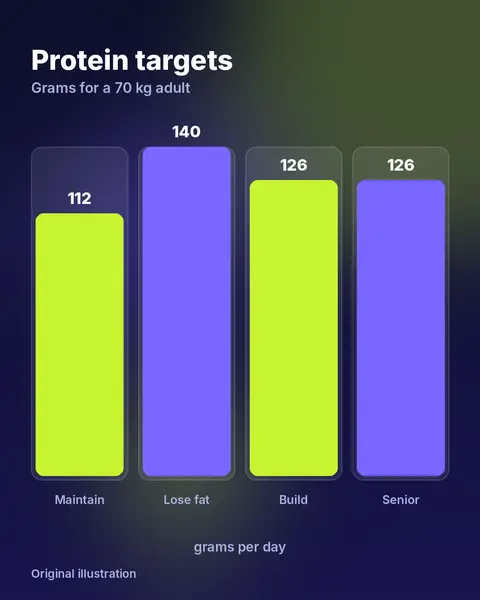
Protein by goal (example: 80 kg man, 35, moderate activity)
| Goal | Protein per day | Per kg |
|---|---|---|
| Maintain | 128 g | 1.6 |
| Build muscle | 144 g | 1.8 |
| Lose fat | 160 g | 2.0 |
| Recomposition | 160 g | 2.0 |
Fat loss needs more protein than maintenance because a calorie deficit raises the risk of losing muscle. The extra protein helps protect it and keeps you fuller.
How to spread protein through the day
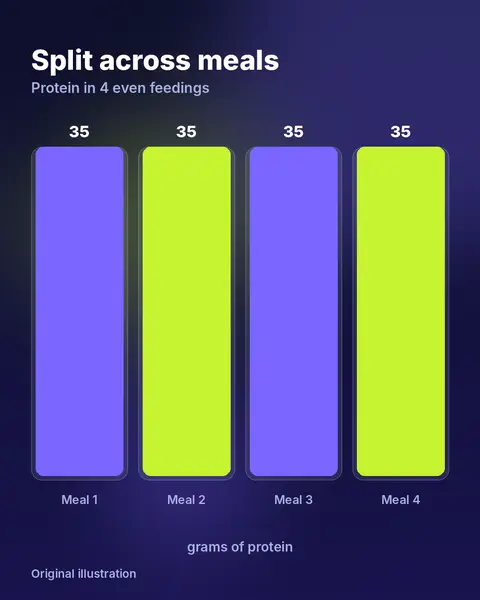
Evidence suggests muscle protein synthesis is stimulated by roughly 0.3-0.4 g/kg per meal, over 3-5 meals (Schoenfeld and Aragon, 2018). For most people that is 25-40 g per meal. Total daily intake matters more than perfect timing.
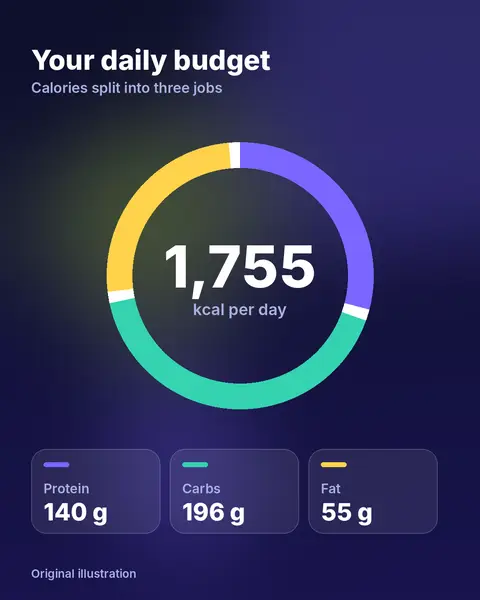
Using the body-fat option
Entering body fat switches the calculator to lean-mass maths. An 80 kg man at 18% body fat has 65.6 kg of lean mass, and in a deficit his target rises to 157 g (about 2.4 g per kg of lean mass), which is nearly the same as using total weight for him. For someone with obesity, lean-mass maths prevents a very large, unnecessary protein number.
Original data: protein per calorie matters in a deficit
Take 160 g of protein. From cooked chicken breast it costs about 850 kcal; from whole eggs about 1,800; from firm tofu about 1,350; from cooked lentils about 2,050 (lentils bring plenty of carbs along with their protein). On a 1,800 kcal diet, chicken would use under half of your calories, while eggs alone would use all of them. Leaner sources free up room for carbs and fat.
Is too much protein harmful?
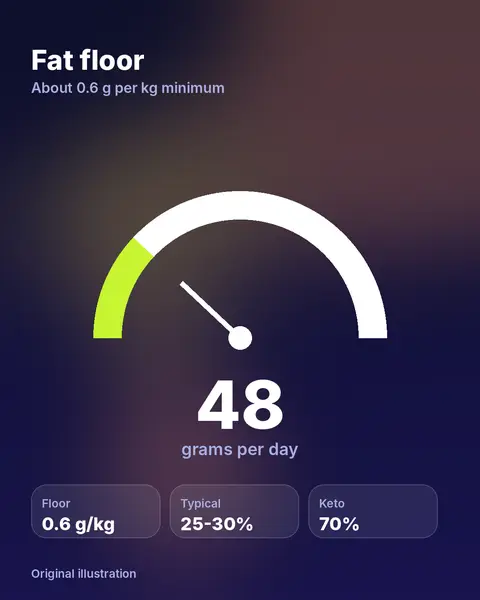
In healthy people, intakes up to about 2-3 g/kg have not been shown to damage kidneys. People with existing kidney disease should follow medical advice. Past about 2.2 g/kg there is little added muscle benefit, so more is not usually better.
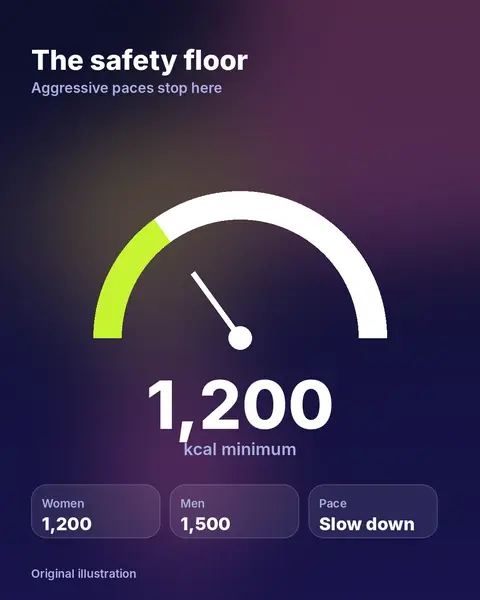
How to use the protein calculator in four steps
- Enter size and activity. Weight is the main input, and body fat (optional) refines the target for people with higher body fat.
- Choose a goal. Fat loss raises the target because protein protects muscle and fullness when calories are low. Maintenance and muscle gain use slightly lower values.
- Read the range. The tool shows a target and a safe band around it, not a single magic number.
- Use the per-meal split. It divides the day into three to five feedings so the grams are practical.
Protein per meal and the leucine idea
Muscle protein synthesis responds to protein in a dose-dependent way until it saturates. Schoenfeld and Aragon (2018) reviewed the literature and concluded that about 0.4 g per kilogram per meal, spread over at least four meals, is a sensible way to reach a daily intake near 1.6 g/kg. For a 75 kg person that is about 30 g a meal. Going higher is not harmful, and total daily protein matters more than exact timing, so the per-meal figure is a guide, not a rule.
Protein needs rise with age
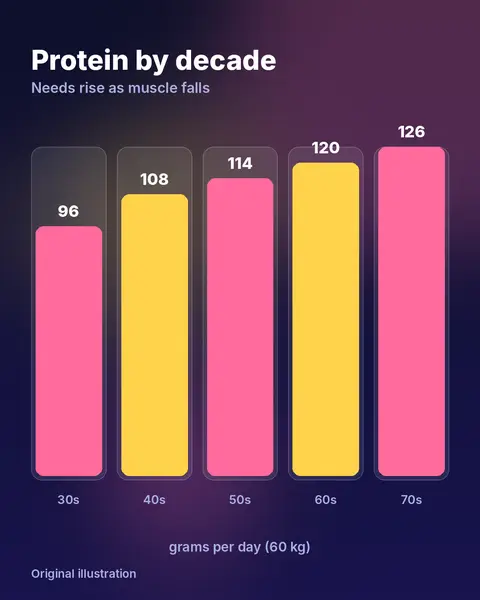
Older adults digest and use protein less efficiently, a pattern researchers call anabolic resistance. The PROT-AGE study group (Bauer et al., 2013) recommended 1.0 to 1.2 g/kg for healthy adults over 65 and 1.2 to 1.5 g/kg for those with illness or injury, well above the 0.8 g/kg minimum. Resistance training amplifies the benefit. The macro calculator for women over 40 applies this logic.
Protein per 100 calories: where the grams are cheapest
When calories are limited, the number that matters is grams of protein per 100 kcal. Using the food values in the site's own list:
| Food (cooked or as sold) | Protein per 100 kcal |
|---|---|
| Shrimp | 24 g |
| Tuna, canned in water | 22 g |
| Turkey breast | 22 g |
| Egg whites | 21 g |
| Chicken breast | 19 g |
| Greek yogurt, nonfat | 17 g |
| Tofu, firm | 12 g |
| Whole eggs | 9 g |
| Lentils | 8 g |
| Paneer | 6 g |
| Peanut butter | 4 g |
A plan built on the top half of this table gets to 140 g of protein for under 800 kcal. A plan built on the bottom half needs well over 1,500.
Our take: what is overrated, underrated and wrong
The "30 g per meal anabolic window" and protein timing around the gym.
Protein for fullness. It is the macro that most reduces hunger on a diet.
Using body weight in pounds as grams of protein for everyone. It is fine for lean lifters, too high for many others.
Who needs a protein intake calculator?
It helps lifters protecting muscle in a deficit, older adults aiming to keep strength and anyone who keeps guessing at a number. A protein intake calculator replaces the guess with a range tied to your weight and goal.
Pair it with the macro calculator to fit protein inside your daily calories.
FAQ
How much protein do I need per day?
Between roughly 1.4 and 2.2 g per kg for active people. Use the calculator for a number tied to your goal.
How much protein per meal?
About 25-40 g, across 3-5 meals.
How much protein to build muscle?
Around 1.6-2.2 g per kg combined with progressive resistance training.
Do women need less protein?
Per kg, no. Women's totals are lower mainly because of lower body weight.
Can I get enough protein on a vegetarian diet?
Yes. See the vegetarian macro calculator for sources and amounts.
Is 1 gram of protein per pound of body weight necessary?
No. One gram per pound equals about 2.2 g/kg, the top end of the researched range. Most people see little extra benefit above 1.6 to 2.0 g/kg.
Does protein timing matter?
Slightly. Total daily protein explains most of the effect, and spreading it over three to five meals is a practical way to hit it.
How do vegetarians reach their protein target?
By combining dairy, eggs, soy, lentils, beans and seitan, and leaning on protein powder when needed. The vegetarian and vegan calculator shows examples.
Sources
- Morton RW, et al. A systematic review, meta-analysis and meta-regression of protein supplementation on resistance training-induced gains. Br J Sports Med. 2018;52:376-84.
- Jäger R, et al. ISSN position stand: protein and exercise. J Int Soc Sports Nutr. 2017;14:20.
- Schoenfeld BJ, Aragon AA. How much protein can the body use in a single meal for muscle-building? J Int Soc Sports Nutr. 2018;15:10.
- Helms ER, et al. J Int Soc Sports Nutr. 2014;11:20.
Related reading: Protein also costs more energy to digest than carbs or fat; the thermic effect of food guide shows by how much.
Keep going
Protein Per Day by Height
A chart of protein ranges by height.
Muscle Gain Macro Calculator
Lean-bulk surplus by training experience.
Weight Loss Macro Calculator
Pace-based deficit with protein that protects muscle.
Food Macro Calculator
Search foods and log against your daily targets.
What Are Macros?
Protein, carbs and fat explained simply.
Macro Calculator for Men
Targets by size, training and goal.