Updated November 3, 2026 · 4 min read · Sources listed at the end
A carb cycling macro calculator sets different carbohydrate targets for training and rest days while keeping weekly calories on plan.
What is carb cycling?
Definition
Carb cycling is a nutrition strategy where daily carbohydrate intake alternates between higher-carb days (usually training days) and lower-carb days (usually rest days), while protein stays high and fat stays roughly constant.
The logic is simple: carbs fuel hard training and recovery, so eat more of them when you train and fewer when you do not. The calculator does it in a way that keeps your weekly calories equal to your target, so you are not accidentally dieting or bulking.
Carb cycling sits on top of a normal plan, so set your base targets with the macro calculator, check maintenance in the TDEE calculator and see how pace affects fat loss in the calorie deficit calculator.
How this calculator cycles carbs
- Pick your goal and calculate your daily numbers as usual.
- Turn on Carb cycling in Advanced settings and choose training days per week.
- Training days receive about 8% more calories, all from carbohydrate.
- Rest days receive a proportional reduction so the weekly average equals your normal target. The fewer rest days, the larger the cut per rest day.
- Protein and fat do not change.
Example: calculator targets of 2,200 kcal/day with training four days a week yields about 2,376 kcal on training days and roughly 1,965 kcal on rest days. Protein and fat stay put; carbs change by around 100 g between the two kinds of day.
| Training days per week | Training-day calories | Rest-day calories |
|---|---|---|
| 2 | +8% | −3.2% |
| 3 | +8% | −6.0% |
| 4 | +8% | −10.7% |
| 5 | +8% | −20% |
| 6 | +8% | −48% |
At 6 training days a week, cycling stops making sense: the single rest day would have to absorb a 48% cut. That is the calculator's way of saying "just eat the same every day."
Who benefits from carb cycling?
| Situation | Helpful? |
|---|---|
| Lifters who train 3-5 days a week | Yes, mild |
| Endurance athletes with hard and easy days | Yes, fueling for the work required |
| Dieters who find low carbs easier on rest days | Yes, psychological comfort |
| People who train 6-7 days | Not much; eat steady |
| Beginners | Optional; focus on consistency first |
What the research says
- Evidence is limited. Controlled studies on carb cycling specifically are small. The best-supported principles remain total calories, protein and training.
- Periodized fuelling. Sports nutrition researchers describe a "fuel for the work required" approach, where carbohydrate availability matches training demands (Impey et al., 2018). Carb cycling is a simple way to apply that idea.
- Adherence matters. Many people find alternating days more flexible; if it adds stress, drop it.
Original data: protein and fat stay constant
A 38-year-old man (88 kg, 24% body fat) at 2,813 kcal on a four-day cycle: training days 3,038 kcal and 415 g carbs; rest days 2,513 kcal and 283 g carbs. Carbs move 132 g (528 kcal) between day types; protein stays at 147 g and fat at 88 g. Weekly average: 2,813 kcal. The cycling affects timing, not totals.
What research says about cycling carbs
The evidence is more modest than the marketing. Seimon and colleagues (2015) reviewed studies of intermittent versus continuous energy restriction and found similar weight loss in both. The MATADOR trial (Byrne et al., 2018) found some benefit for two-week on and off cycles in fat loss and metabolic rate, but the result comes from a small sample. For training, carbohydrate is clearly useful: Burke and colleagues (2011) recommend matching carbohydrate intake to training load, with more on hard days and less on rest days. Nutrient timing reviews (Aragon and Schoenfeld, 2013) conclude that total daily protein and calories matter far more than the hour of the meal.
The honest summary is that carb cycling works when it makes a plan easier to follow or fuels hard sessions, not because of any special metabolic effect.
Sample week for a 2,200 kcal target
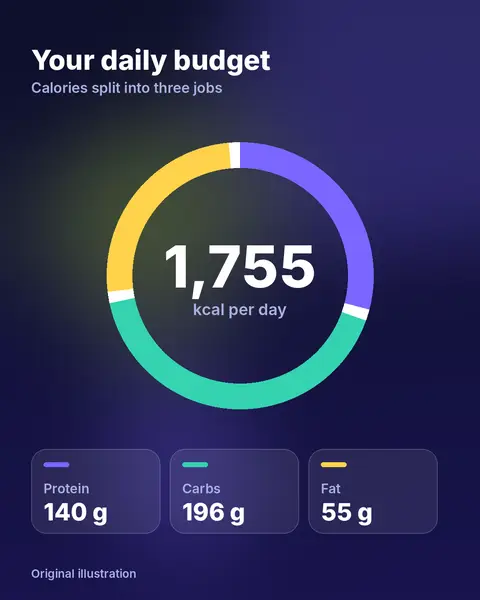
With four training days, the calculator gives about 2,376 kcal on training days and 1,965 kcal on rest days. Protein and fat stay constant, so the 411 kcal swing comes entirely from carbohydrate: roughly 100 g more on training days. The weekly average is still 2,200 kcal.
Our take: what is overrated, underrated and wrong
Dramatic "refeed" days with huge carb loads. Mild, consistent adjustments work just as well.
Just eating more carbs around training sessions. That alone captures most of the benefit.
Believing carb cycling is a fat-loss hack. Weekly calories still decide the result.
FAQ
How do I carb cycle for fat loss?
Calculate your deficit, turn on cycling and eat more carbs on training days. Keep protein constant. The weekly calories remain the same as without cycling.
How many high-carb days per week?
Match them to hard training days, usually 3-4. If you train daily, don't cycle.
Does carb cycling boost metabolism?
Not meaningfully. It is a way to organize your food around training.
Can I carb cycle on keto?
Targeted or cyclical keto exists, but it is advanced. Start with a steady plan first.
Do I need to count macros to carb cycle?
You need at least a basic plan for carbs on high and low days. The calculator gives you the grams.
Is carb cycling better than eating the same every day?
Not for fat loss on its own. It can help fuel training and feel easier for people who like variety.
Should rest-day carbs be very low?
No. A moderate drop is enough, and the calculator's cuts keep protein and fat the same.
Sources
- Dietary Guidelines for Americans (USDA and HHS)
- Impey SG, et al. Fuel for the work required: a theoretical framework for carbohydrate periodization and the glycogen threshold hypothesis. Sports Med. 2018;48(5):1031-1048.
- Burke LM, Hawley JA, Wong SH, Jeukendrup AE. Carbohydrates for training and competition. J Sports Sci. 2011;29(S1):S17-S27.
- Jager R, et al. J Int Soc Sports Nutr. 2017;14:20.
Keep going
Body Recomp Calculator
Maintenance calories, high protein, smart carb cycling.
Bodybuilding Calculator
Lean-mass bulk and cut macros.
Weight Loss Macro Calculator
Pace-based deficit with protein that protects muscle.
IIFYM Calculator
Flexible dieting macros and guardrails.
Macro Percentage Calculator
Turn a calorie target and percentage split into grams.
Muscle Gain Macro Calculator
Lean-bulk surplus by training experience.