MacroCalculatorPro Editorial TeamUpdated November 20, 2026 · 8 min read · Category:
Nutrition Science · Sources listed at the end
So, are calorie counts on food labels accurate? Mostly, within a margin: packaged foods usually land reasonably close to the printed number, restaurant and reduced-calorie foods can run higher, and some foods deliver fewer calories than stated. Here is where the gaps come from and how to track around them.
The short answer: how accurate are calorie counts on food labels?
Calorie counts on food labels are good estimates, not exact measurements. Packaged foods usually land reasonably close to the printed number, restaurant and reduced-calorie foods can run higher, and a few foods, such as nuts, deliver fewer calories than the label says. The rest of this guide shows where the gaps come from, how large they are, and how to track around them.
The practical conclusion is reassuring: label error is real, but it is often smaller than other sources of error, and a weekly weight trend corrects most of it.
What a calorie count on a food label actually means
Definition
A calorie count on a food label is a calculated estimate of the energy in one serving, usually built from the grams of protein, carbohydrate and fat using Atwater factors: about 4 kcal per gram for protein and carbohydrate, 9 kcal per gram for fat and 7 kcal per gram for alcohol.
Wilbur Atwater developed these averages in the 1890s by burning foods and measuring what people absorbed. Manufacturers can also use more specific factors for individual foods, or direct lab analysis. The result then gets rounded: under 5 kcal can be shown as 0, values up to 50 kcal are rounded to the nearest 5, and larger values to the nearest 10.
Those rounding steps alone can move a single serving by a few calories, which explains why a "100 calorie pack" never contains exactly 100.
What the FDA allows on calorie labels
The rule often summarised as "20% margin of error" is narrower than it sounds. Under 21 CFR 101.9(g), a food counts as misbranded when its measured calories exceed the declared value by more than 20%, which sets a ceiling at 120% of the label. There is no matching 80% floor for calories, so a food that delivers fewer calories than stated does not break the rule.
| Nutrient | Compliance rule |
|---|
| Calories, total fat, saturated fat, sodium, sugars | Measured value may not exceed 120% of the label |
| Protein, fibre, vitamins, minerals (naturally present) | Measured value must reach at least 80% of the label |
Independent measurements, covered below, show how foods behave in practice.
Where the error comes from
- Rounding and serving size. Small per-serving errors multiply when a person eats two or three servings.
- Natural variation. Ingredients differ by batch, crop and season, so one printed number must cover many production runs.
- Atwater averages. The 4-4-9 factors assume average digestibility. Foods with tough cell walls or lots of fibre deliver fewer calories than the formula predicts.
- Preparation. Cooking, grinding and blending change how much energy the body can extract from the same ingredients.
- Restaurant portions. Chefs plate by eye, and recipes change over time, which makes menu numbers less reliable than factory numbers.
What studies measured
Three studies give the clearest numbers, and they point in different directions:
| Study | What was tested | Result |
|---|
| Urban et al., 2010 | 29 quick-serve and sit-down restaurant foods, advertised as reduced-energy | Measured energy averaged 18% above the stated value; some items reached 200% |
| Urban et al., 2010 | 10 supermarket frozen meals | Averaged 8% above the stated value |
| Novotny et al., 2012 | Whole almonds fed to 18 adults in a controlled crossover trial | About 129 kcal per 28 g serving instead of the roughly 170 kcal Atwater factors predict |
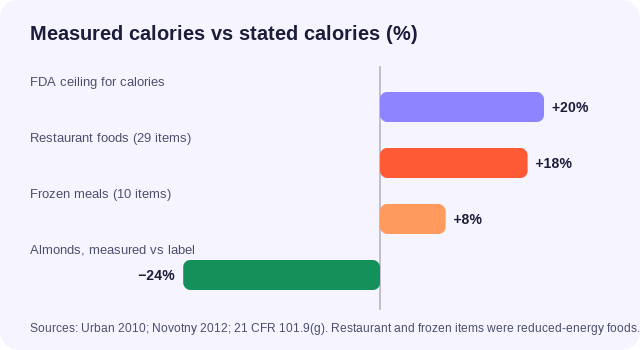 Measured calories compared with stated calories. Sources: Urban 2010, Novotny 2012, 21 CFR 101.9(g).
Barr and Wright (2010) add a related point about digestion: a whole-food meal can cost roughly twice as much energy to process as a processed meal with the same calories, one more reason two foods with identical labels do not behave identically. See the thermic effect of food for the details.
Worked example: an error budget for one day
The table logs a 2,000 kcal day and applies the average study differences to three items. It illustrates scale; it does not predict any single meal.
| Logged item | Logged kcal | Assumed difference | Likely actual kcal |
|---|
| Restaurant lunch | 800 | +18% | 944 |
| Frozen dinner | 350 | +8% | 378 |
| 28 g almonds | 170 | −24% | 129 |
Original data
The restaurant meal adds about 144 kcal, the frozen meal 28 kcal and the almonds subtract about 41 kcal. Net result: roughly +131 kcal, or about 6.5% of the 2,000 kcal logged. A 6.5% drift is real, and it is also smaller than the 10% to 20% error typical of calorie equations, which is why a two-week weight average beats any single label as a check.
How to track calories despite label error
- Weigh, do not measure by volume. Grams beat cups, and a food scale removes the biggest source of home-cooking error.
- Add a buffer to restaurant meals. Based on the 18% average above, many people add 10% to 20% to menu numbers, which is a practical rule rather than a regulation.
- Prefer verified database entries. Apps with barcode data and user edits vary in quality; the best macro tracking apps guide compares how they handle this.
- Stay consistent. A steady 5% bias disappears into your baseline, because maintenance is estimated from the same logging habits. Consistency matters more than precision.
- Judge by the trend. If your two-week average weight does not follow the plan, change calories by 100 to 150 kcal instead of arguing with a label. The calorie calculator shows the projected trend to compare against.
Does label error explain a weight loss plateau?
Sometimes, but usually in combination with other causes. A 6% logging drift on 1,800 kcal is about 110 kcal a day, which can erase a 250 kcal deficit by almost half. The usual suspects, such as weekend eating, cooking oils and portion creep, add to it. The seven reasons macros stop working guide walks through the checks in order, and the calorie deficit calculator shows how much margin a given pace leaves.
Exercise numbers carry error too; the calories burned calculator explains why wearable estimates drift more than labels do.
Our take: what is overrated, underrated and wrong
OverratedPanic about the "20% rule". It is a ceiling on one side, not a licence for every product to be off by 20%.
UnderratedWeighing food and keeping the logging method steady. Consistent bias cancels out; random sloppiness does not.
Usually wrongTreating a label as precise to the calorie, or throwing out tracking because labels are imperfect. Both extremes ignore the middle: a good estimate corrected by the scale.
FAQ
Are calorie counts on food labels accurate?
They are estimates. Packaged foods usually land reasonably close to the printed value, while restaurant and reduced-calorie foods can run higher and some foods, such as nuts, deliver fewer calories than the label states.
What margin of error does the FDA allow on calories?
A food is misbranded when its calories exceed the label by more than 20%, so the ceiling is 120% of the stated value. There is no 80% floor for calories.
Are restaurant calorie counts accurate?
Less so than packaged foods. In one study of 29 reduced-energy restaurant items, measured calories averaged 18% above the stated values.
Do nuts have fewer calories than the label says?
In a controlled trial, whole almonds provided about 129 kcal per 28 g serving, around a quarter fewer than the roughly 170 kcal that standard factors predict.
What are Atwater factors?
They are the average energy values used for labels: about 4 kcal per gram of protein and carbohydrate, 9 per gram of fat and 7 per gram of alcohol.
Does cooking change calories?
It can change how many calories you absorb. Grinding, heating and blending break food structure down, which usually makes more energy available.
Should I stop counting calories because labels are inaccurate?
No. Label error is often smaller than the error in calorie equations and gets corrected by tracking your weekly weight trend.
How can I reduce calorie tracking errors?
Weigh food in grams, add a 10% to 20% buffer to restaurant meals, use verified database entries and adjust calories by 100 to 150 kcal when the weekly trend disagrees with the plan.
Sources