MacroCalculatorPro Editorial TeamUpdated November 20, 2026 · 8 min read · Category:
Nutrition Science · Sources listed at the end
The thermic effect of food is the energy your body spends digesting, absorbing and storing what you eat, and it accounts for roughly 10% of the calories in a mixed diet. This guide gives the numbers for protein, carbohydrate, fat and alcohol, shows a worked example and explains what changes the effect in real meals.
What is the thermic effect of food?
Definition
The thermic effect of food (TEF) is the energy your body spends to digest, absorb, transport and store the food you eat. Researchers also call it diet-induced thermogenesis (DIT), and older papers use the term specific dynamic action.
Every meal raises your metabolic rate for a few hours. Part of that rise is obligatory: the gut, liver and other organs must do real work, such as breaking bonds, moving nutrients across membranes and building molecules like glycogen or protein. The rest is facultative, a smaller, nerve-driven component linked to the sympathetic nervous system.
TEF is one of four parts of daily energy use, next to resting metabolic rate (BMR), exercise and non-exercise movement (NEAT). In a person eating a mixed diet, it comes to about 10% of the calories eaten, and reviews give a range of 5% to 15%.
What people really want to know about TEF
Searches about the thermic effect of food usually come from four frustrations:
- "Does protein really burn 30% of its own calories?" Only at the top of a range, and only for protein as a nutrient, not for a whole day of eating.
- "Should I subtract TEF from my calories?" No. Calorie targets already include it, and the sections below show why.
- "Can I eat more small meals to burn more?" The arithmetic says no, because TEF scales with the total energy eaten, not with the number of meals.
- "Is a high-TEF diet worth planning around?" Slightly, mostly because protein and whole foods also keep people fuller. The honest size of the effect is small.
Where TEF fits in your daily energy use
Total daily energy expenditure (TDEE) has four building blocks:
| Component | What it covers | Typical share of TDEE |
|---|
| BMR | Breathing, circulation, organ upkeep at rest | 60 to 70% |
| NEAT | Walking around, fidgeting, chores, posture | 15 to 30%, varies most |
| Exercise | Planned workouts and sport | 0 to 15% |
| TEF | Digesting and storing what you eat | About 8 to 10% |
Look at the last row. TEF is the smallest of the four and the least adjustable, which is why large changes to TEF rarely show up on the scale. Most calculators fold it into the activity multiplier instead of adding it separately; see how the TDEE calculator builds maintenance calories from BMR and activity.
TEF by protein, carbs, fat and alcohol
Different nutrients cost different amounts of energy to process. Westerterp (2004) summarised the ranges that most later papers repeat:
| Nutrient | Thermic effect | Why it differs |
|---|
| Protein | 20 to 30% | Amino acids need ATP to build new proteins, and the liver spends energy turning nitrogen into urea. |
| Alcohol | 10 to 30% | The liver must metabolise it first, ahead of other fuels. |
| Carbohydrate | 5 to 10% | Converting glucose to glycogen has a modest energy cost. |
| Fat | 0 to 3% | Dietary fat is stored in fat cells with very little reprocessing. |
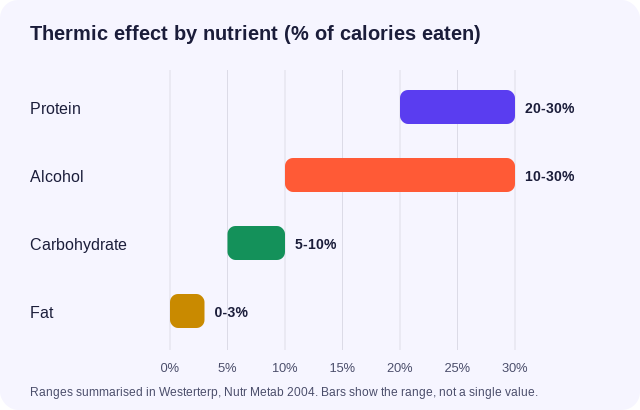 Ranges for the thermic effect of food, by nutrient. Source: Westerterp 2004.
The percentages describe the share of a nutrient's own calories that the body spends on processing it. A meal that contains 100 kcal of protein therefore costs about 20 to 30 kcal to handle, leaving 70 to 80 kcal as usable energy.
Worked example: three diets, the same 2,000 calories
The table applies midpoint values (protein 25%, carbohydrate 7.5%, fat 1.5%) to three ways of eating 2,000 kcal. Alcohol is left out to keep the comparison simple.
| Macro split (P/C/F) | Protein kcal | Carb kcal | Fat kcal | Estimated TEF |
|---|
| 15/55/30 (lower protein) | 300 | 1,100 | 600 | 167 kcal (8.3%) |
| 25/45/30 (typical) | 500 | 900 | 600 | 202 kcal (10.1%) |
| 35/40/25 (higher protein) | 700 | 800 | 500 | 243 kcal (12.1%) |
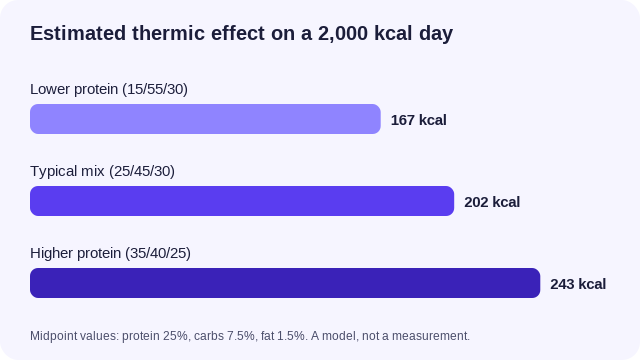 Estimated thermic effect on three 2,000 kcal diets, using midpoint values.
Original data
Moving from the typical mix to the higher-protein mix raises estimated TEF by about 41 kcal a day. Over 30 days that is roughly 1,230 kcal, or about 0.16 kg of fat. Between the lowest and highest protein diets the gap is about 76 kcal a day. Using the low and high ends of each nutrient range instead of midpoints, the typical mix could burn anywhere between roughly 145 and 258 kcal.
The takeaway is practical. Protein shifts the thermic effect by dozens of calories, not hundreds. The weight-management value of a higher protein share lies mostly elsewhere, in fullness and muscle retention.
What changes the thermic effect of food in real meals
- Total calories eaten. Westerterp's review calls the energy content of a meal the main determinant. Bigger meals produce a bigger absolute response, so TEF scales with intake.
- Protein share. Across 19 studies in that review, every extra 1% of energy from protein raised the response only a little, which fits the idea of a modest, steady effect.
- Food processing. Barr and Wright (2010) fed 17 young adults a whole-food sandwich meal and a processed-food meal of similar calories. The whole-food meal produced roughly twice the thermic response, about 20% of meal energy compared with about 10%.
- Meal frequency. Six small meals and three large ones add up to the same calories, so they produce about the same TEF over a day. The popular "stoke the furnace" advice has no basis in the arithmetic.
- Body size and body composition. Some studies report a lower response in people with obesity, but results disagree and methods vary, so no firm rule applies.
Does a high-TEF diet help with weight loss?
A little. Choosing minimally processed foods and enough protein raises TEF by tens of calories a day, which is real but smaller than the error in most calorie estimates. The stronger reasons to eat that way are different: protein and fibre-rich whole foods are more filling, and enough protein helps preserve muscle in a calorie deficit.
For a concrete target, the protein intake calculator gives a daily range from body weight and goal. The protein by height chart offers a quick cross-check, and the weight loss macro calculator fits that protein inside a deficit.
Our take: what is overrated, underrated and wrong
OverratedChasing a "high-TEF" food list. Celery does not burn more than it contains, and individual foods move the needle far less than total intake does.
UnderratedFood processing. A whole-food meal can cost about twice as much to digest as a processed one with the same calories, and it usually fills people more.
Usually wrongThe claim that eating every two or three hours "speeds up" metabolism. TEF follows total calories, so splitting the same food into more meals changes nothing.
How to use TEF in your own numbers
- Do not subtract it. A calorie target already assumes you digest your food. Subtracting TEF again counts it twice.
- Do not add it as exercise. It belongs to the maintenance figure, not to the workout column in the calories burned calculator.
- Use it as a tiebreaker. When two options fit your calories, pick the one with more protein and fewer ultra-processed ingredients.
- Judge by the scale trend. Maintenance moves with all four components. Weekly averages from the calorie calculator workflow show where you really stand.
Wondering how much trust to place in the calorie numbers themselves? Read are calorie counts on food labels accurate for the other half of the picture.
FAQ
What is the thermic effect of food?
It is the energy the body uses to digest, absorb and store food. In a mixed diet it equals about 10% of the calories eaten, with a reported range of 5% to 15%.
What is the thermic effect of protein?
Roughly 20% to 30% of the calories in protein are spent on processing it, compared with 5% to 10% for carbohydrate and 0% to 3% for fat.
Is TEF included in my TDEE?
Yes. Maintenance calories already include it, so it should not be added or subtracted again.
Do small frequent meals increase thermic effect?
No. TEF depends on total energy eaten, so the same food split into more meals gives about the same total.
Do spicy foods or caffeine raise TEF?
Effects are small and short-lived in most trials, so they should not change calorie targets.
Does a high-protein diet burn more calories?
Slightly. On a 2,000 kcal diet, moving from 25% to 35% protein raises estimated TEF by roughly 40 kcal a day, which is a small amount.
Does processed food have a lower thermic effect?
In a small crossover study, a processed-food meal produced about half the thermic response of a whole-food meal with similar calories. More research would help confirm the size of the gap.
How is the thermic effect of food measured?
Researchers use indirect calorimetry, measuring oxygen use and carbon dioxide output for several hours after a meal, or for 24 hours in a whole-room chamber.
Sources